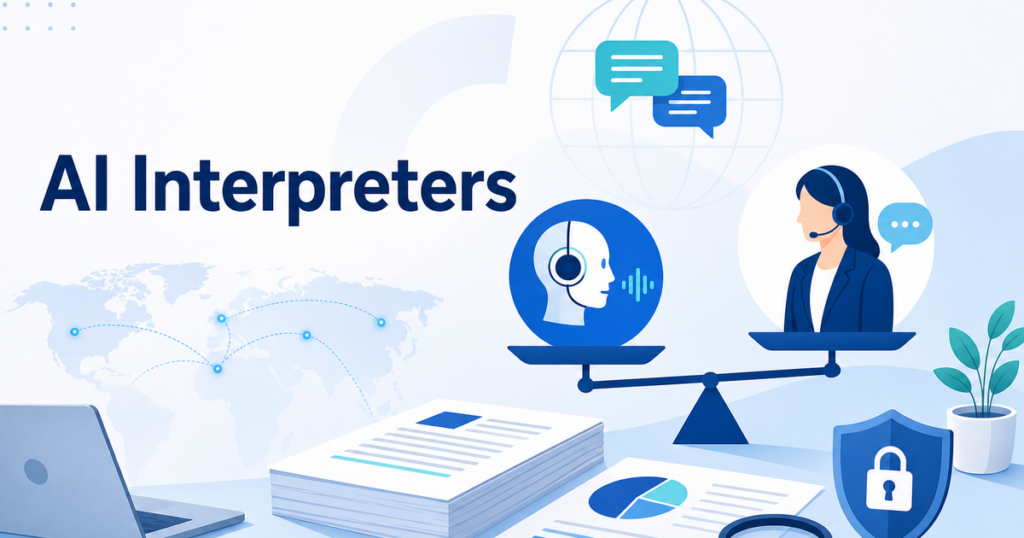
Business meetings happen across language lines every day. A sales call with a prospect in Tokyo, a project kickoff with a team in Munich, a compliance review with a partner in Shanghai. Each of these moments needs interpretation, and the question facing more teams is whether to rely on an AI interpreter, a human interpreter, or some combination of both.
This is not a simple either-or decision. AI interpretation has improved dramatically, but human interpreters still hold clear advantages in specific situations. Understanding when each approach makes sense helps you allocate budget wisely and avoid miscommunication where it matters most.
What AI Interpreters Do Well
AI-powered interpretation tools convert spoken language from one language to another in real time, using a combination of automatic speech recognition, machine translation, and text-to-speech synthesis. Some tools produce translated text captions, while others generate spoken output.
Everyday Internal Meetings
For routine internal communication, team standups, project check-ins, status updates, and similar formats, AI interpretation provides a practical way to include multilingual team members without the cost and logistics of booking a human interpreter.
These meetings tend to be predictable in structure and vocabulary. Participants speak in short turns, topics are familiar, and the consequences of a minor mistranslation are low. If a word is translated incorrectly, someone can easily ask for clarification without derailing the conversation.
Ad Hoc and Unplanned Conversations
One of the biggest advantages of AI interpretation is availability. You do not need to schedule it in advance. When an unexpected call comes in from a colleague who speaks another language, an AI tool can be activated immediately.
This spontaneity is valuable in fast-paced environments where waiting 24 hours to book an interpreter is not realistic. Product teams coordinating across time zones, support engineers troubleshooting with overseas clients, and managers handling urgent escalations all benefit from on-demand interpretation.
Budget-Conscious Scenarios
Human interpretation often involves separate scheduling, vendor coordination, and professional fees. Depending on language pair, region, meeting length, and subject matter, those costs can become meaningful for organizations that run multilingual meetings regularly.
AI interpretation tools may be easier to budget for when they are sold as subscriptions or per-user products. For high-volume, low-stakes communication, they can be worth evaluating as a lower-friction option, but the outcome depends on meeting risk, language pair, audio quality, and review expectations.
Training and E-Learning Sessions
When the goal is to transfer knowledge rather than negotiate terms, AI interpretation works well. Training sessions, onboarding modules, and e-learning courses that include live instruction benefit from real-time translation because learners can follow along at their own pace and refer back to recorded content with translated captions.
What Human Interpreters Do Better
Despite rapid advances, AI interpretation has meaningful limitations. Certain situations call for the nuance, cultural awareness, and reliability that only a trained human professional can provide.
High-Stakes Negotiations and Legal Settings
When the outcome of a conversation has significant financial or legal implications, accuracy is not optional. A single mistranslated word in a contract negotiation, settlement discussion, or regulatory hearing can change the meaning of an entire agreement.
Human interpreters trained in legal or conference interpretation follow strict protocols. They maintain accuracy standards, manage terminology carefully, and can flag ambiguities in real time. AI tools, by contrast, can produce fluent-sounding output that subtly alters meaning in ways that are hard to detect without a bilingual listener monitoring the translation.
Medical and Healthcare Communication
In healthcare settings, interpretation errors can directly affect patient safety. Diagnoses, treatment plans, informed consent conversations, and medication instructions all require precise communication. Human interpreters with medical training understand clinical terminology, can recognize when a patient has not understood an explanation, and know how to handle sensitive topics with appropriate care.
AI tools may serve as a supplemental resource in non-critical healthcare interactions, but they should not replace trained medical interpreters for patient-facing communication.
Diplomatic and Government Contexts
Government meetings, diplomatic exchanges, and official proceedings demand interpretation that accounts for tone, register, cultural nuance, and political sensitivity. A phrase that is technically correct but culturally tone-deaf can damage relationships or create misunderstandings that persist for years.
Professional interpreters working in these contexts bring years of training and experience. They understand when to interpret literally and when to convey intent. They also follow confidentiality and ethical standards that AI tools are not designed to uphold.
Complex or Technical Subject Matter
Highly specialized fields such as patent law, aerospace engineering, pharmaceutical research, and financial regulation use dense, precise vocabulary that general-purpose AI models may not handle reliably. Human interpreters who specialize in these fields maintain glossaries, study reference materials before assignments, and can ask for clarification when a term is ambiguous.
AI tools are improving in specialized domains, but they still struggle with uncommon terminology, newly coined terms, and field-specific abbreviations that are not widely represented in training data.
The Hybrid Approach: Getting the Best of Both
In practice, many organizations benefit from combining AI and human interpretation rather than choosing one exclusively.
Tiered Strategy by Meeting Type
A practical framework is to categorize meetings by stakes and complexity, then assign the appropriate interpretation method:
- Tier 1: Low stakes, routine. Use AI interpretation. Examples include daily standups, informal check-ins, and internal announcements.
- Tier 2: Moderate stakes, structured. Use AI interpretation with a bilingual team member monitoring for accuracy. Examples include project reviews, vendor calls, and cross-functional meetings.
- Tier 3: High stakes, complex. Use human interpreters. Examples include contract negotiations, legal proceedings, executive-level presentations, and any meeting with regulatory implications.
This tiered approach lets you control costs while ensuring quality where it matters most.
Human Review of AI Output
Even when using AI interpretation for convenience, having a bilingual team member spot-check the translation can catch errors before they cause problems. This is especially valuable in meetings where the AI tool occasionally struggles with a speaker's accent, speed, or use of industry-specific terms.
Sequential Interpretation for Critical Segments
Some meetings contain a mix of routine and critical content. In these cases, you might use AI interpretation for the general discussion and switch to a human interpreter for the specific segments that require higher accuracy, such as the portion of a call where terms and conditions are discussed.
Disclosure and Transparency
Regardless of which approach you choose, transparency with all participants is important.
Informing Participants
When AI interpretation is used, meeting participants should be informed that the translation is generated by an automated system and may contain errors. This is especially important when one party might assume a human interpreter is mediating the conversation.
Recording and Archiving
If a meeting is recorded and the AI interpretation is captured, make it clear in the recording metadata that the translation was machine-generated. This prevents future reviewers from treating the translated transcript as an officially verified record of what was said.
Ethical Considerations
In some professional contexts, using AI interpretation without disclosure raises ethical concerns. Legal, medical, and government settings often have explicit requirements about how interpretation is provided and who is qualified to deliver it. Even outside these regulated domains, transparency builds trust and sets appropriate expectations.
Evaluating AI Interpretation Quality
If you decide to use AI interpretation for certain meeting types, periodically evaluate its performance to make sure it meets your standards.
Accuracy Sampling
Record a sample of meetings with AI interpretation active. Have a bilingual reviewer compare the original speech against the AI output and note errors, omissions, and mistranslations. Track these over time to identify patterns.
Speaker and Context Variables
AI interpretation quality varies based on several factors:
- Speaker clarity. Clear, well-paced speech produces better results.
- Accent and dialect. Some tools handle certain accents better than others.
- Background noise. Noisy environments degrade speech recognition accuracy.
- Technical vocabulary. Specialized terms may be mistranslated or omitted.
- Number of speakers. Meetings with many participants speaking in rapid succession are harder to translate accurately than structured conversations with clear turn-taking.
Understanding these variables helps you decide when AI interpretation is likely to perform well and when to bring in human support.
Practical Recommendations
Start with AI, Escalate to Human
For most organizations, a pragmatic approach is to start with AI interpretation for all multilingual meetings and escalate to human interpreters for meetings that meet specific criteria: legal significance, high financial stakes, healthcare communication, or executive-level negotiations.
Invest in Speaker Training
The quality of AI interpretation depends heavily on how people speak. Training presenters and meeting participants to speak clearly, avoid overlapping speech, and minimize jargon can significantly improve translation accuracy without additional cost.
Build a Terminology Glossary
If your organization frequently discusses specialized topics, maintain a glossary of key terms with their approved translations. Share this glossary with both AI tool providers and human interpreters to ensure consistency.
Review Regularly
AI interpretation technology is evolving quickly. A tool that struggled with a particular language pair or accent six months ago may perform much better today. Schedule periodic reviews to reassess whether your current tool choices still meet your needs.
Cost Comparison: What to Expect
Understanding the cost differences helps you budget appropriately. While specific prices vary by provider and region, the relative differences between approaches are consistent.
AI Interpretation Costs
AI interpretation tools typically use one of three pricing models: subscription-based (monthly or annual fee per user), usage-based (charged by the minute or hour of translation), or a combination of both. For organizations that use interpretation regularly, a subscription model is usually more cost-effective.
The key advantage is predictability. You pay the same amount whether you use interpretation for one meeting or thirty meetings in a month, which makes budgeting straightforward.
Human Interpreter Costs
Professional interpreter pricing varies by provider, language pair, subject matter, region, and assignment type. Some assignments are billed by the hour, while others may use half-day, full-day, or project-based terms.
For simultaneous interpretation (where the interpreter speaks at the same time as the original speaker), you typically need two interpreters per language pair, because they alternate every 20 to 30 minutes to maintain accuracy. This can increase staffing needs and overall cost compared with some consecutive interpretation arrangements.
When the Cost Difference Matters Most
The cost difference between AI and human interpretation becomes most significant for organizations that run multilingual meetings daily or weekly. AI meeting translation may lower cost for some recurring meetings, but the actual economics depend on meeting volume, risk level, language pair, and whether a human interpreter is still required.
For occasional use, such as a quarterly board meeting or an annual conference, the cost of human interpreters is more justifiable because the volume is low and the stakes are high.
Security and Data Privacy Considerations
Where Audio Data Goes
AI interpretation tools process audio through cloud-based servers. This means that the audio from your meetings passes through third-party infrastructure. For meetings that discuss proprietary information, trade secrets, or personal data, this raises legitimate security concerns.
Before selecting an AI interpretation tool, review the provider's data handling policies:
- Is audio data stored after processing, or is it deleted immediately?
- Where are the processing servers located?
- Does the provider use meeting audio to train its models?
- What encryption is used for data in transit and at rest?
Human interpreters are bound by confidentiality agreements and professional ethics codes. If your meetings involve highly sensitive information, this legal and ethical framework may provide stronger protection.
Compliance Requirements
Organizations in regulated industries such as healthcare, finance, and government may have specific requirements about how meeting audio is processed and stored. AI interpretation tools that process data outside your organization's security perimeter may not meet these requirements.
In these cases, human interpreters who have signed appropriate confidentiality agreements and who operate within your organization's security framework may be the only compliant option.
Building an Interpretation Policy for Your Organization
Rather than making ad hoc decisions for each meeting, develop a formal interpretation policy that covers:
- Which meetings require interpretation. Define the criteria, such as meetings with participants from specific regions, meetings above a certain level of seniority, or meetings that discuss specific types of content.
- Which approach to use. Specify when AI interpretation is sufficient and when human interpreters are required. Reference the tiered framework described earlier in this article.
- Disclosure requirements. State when and how participants must be informed that AI interpretation is being used.
- Data handling. Document how interpretation data is processed, stored, and protected.
- Quality monitoring. Describe how interpretation quality is evaluated and who is responsible for monitoring.
Having this policy in writing ensures consistency across the organization and gives meeting organizers clear guidance without needing to make judgment calls for every meeting.
Making the Right Choice for Your Team
There is no universal answer to the AI versus human interpreter question. The right choice depends on what is at stake, who is in the room, and what resources you have available. By understanding the strengths and limitations of each approach and applying a tiered strategy, you can provide effective language access across your organization without overpaying for situations where AI is sufficient or under-investing in situations where only a human professional will do.