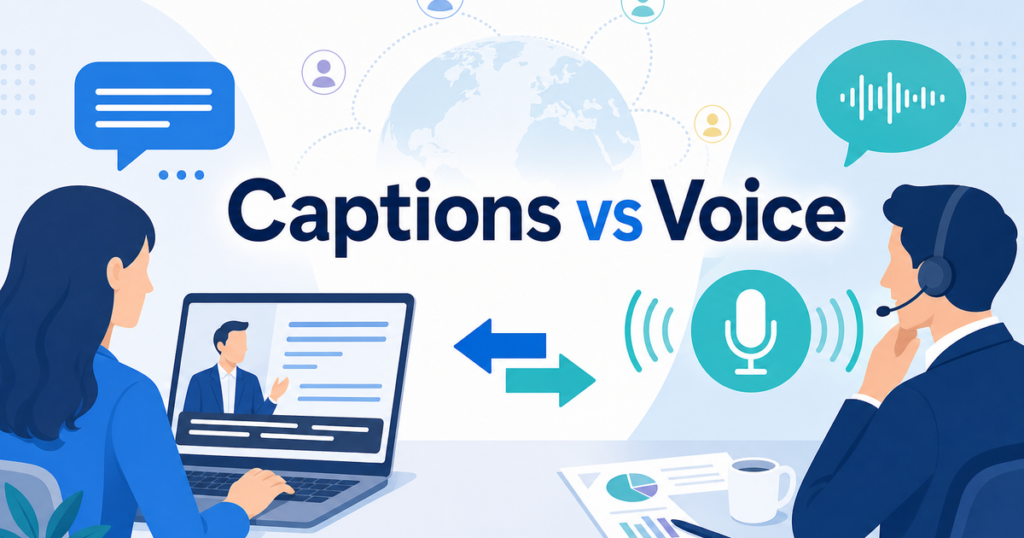
When a meeting involves participants who speak different languages, you need a way to bridge the gap. Two broad approaches dominate: text-based live captions that appear on screen, and voice-based interpretation that provides spoken translation. Both have improved significantly in recent years, and both have distinct strengths and weaknesses depending on the meeting context.
This article breaks down the differences between live captions and voice interpretation, explains the subtypes within each category, and helps you decide which approach fits your specific meeting scenarios.
Understanding the Options
Before comparing, it helps to understand exactly what each term covers, because the landscape has grown more nuanced than many people realize.
Live Captions
Live captions are real-time text transcriptions of spoken audio. They appear on screen as participants speak, converting speech to text using automatic speech recognition technology. Captions can be in the same language as the speaker or translated into a different language.
Subtypes of live captions:
- Same-language captions. The speaker speaks English and the captions display English text. This is primarily an accessibility feature for participants who are deaf or hard of hearing, or for anyone in a noisy environment.
- Translated captions. The speaker speaks one language and the captions appear in another. This is the form most relevant to multilingual meetings, as it lets participants read a real-time translation of what is being said.
Voice Interpretation
Voice interpretation provides spoken output in the target language. Instead of reading text on screen, participants hear the translation through their headphones or speakers.
Subtypes of voice interpretation:
- Human interpretation. A trained professional interpreter listens to the original speech and produces a spoken translation in real time. This can be simultaneous (the interpreter speaks at the same time as the original speaker) or consecutive (the interpreter speaks after the original speaker pauses).
- AI voice interpretation. An AI system processes the original speech and generates spoken translation using text-to-speech synthesis. This produces an audible translation without a human interpreter.
Comparing Live Captions and Voice Interpretation
Comprehension Speed
Voice interpretation has an advantage here. Most people process spoken language faster than they read captions, especially in their native language. When you hear a translation spoken aloud, you can focus on the speaker's facial expressions and body language while absorbing the meaning through audio.
With captions, your attention is split between watching the speaker and reading the text at the bottom of the screen. In fast-moving meetings, you may fall behind if captions appear with any delay.
Accuracy
Voice interpretation, especially human interpretation, tends to be more accurate. Human interpreters can ask for clarification, recognize context-dependent meanings, and handle ambiguity. They also tend to produce grammatically natural output because they understand the full sentence before translating it.
AI captions can be highly accurate for clear, well-paced speech in common language pairs, but they translate sentence fragments as they arrive, which sometimes leads to awkward phrasing or incorrect word choices that a human would avoid.
AI voice interpretation accuracy depends on both the speech recognition and the translation step, so errors can compound. However, spoken output sometimes sounds more coherent than caption text because text-to-speech systems smooth over minor grammatical issues.
Multitasking and Attention
Captions require visual attention. If a participant is taking notes, reviewing a document, or looking at a shared screen, they cannot simultaneously read captions. This is a real problem in meetings where participants need to look at slides, spreadsheets, or other visual materials.
Voice interpretation frees visual attention. Participants can look at shared content while listening to the translation, making it easier to follow presentations that include detailed visuals.
Privacy and Meeting Dynamics
Captions are more discreet. Translated text on screen is visible only to the person reading it (or to everyone, depending on how it is configured). There is no audible output that might distract other participants.
Voice interpretation requires headphones for individual use or affects the entire meeting audio if broadcast to all participants. In meetings where only one or two people need translation, captions may be less intrusive.
Number of Languages Supported
Captions can often support more simultaneous languages. In platforms like Teams, different participants can select different caption languages at the same time. One person reads Spanish captions while another reads Japanese, all from the same English audio stream.
Voice interpretation is typically limited to one target language per audio channel unless the platform supports multiple interpretation streams. This means it works best when most participants who need translation share a common target language.
Cost and Accessibility
Captions are generally cheaper and easier to set up. Most major meeting platforms include translated captions on at least some plans. There is no need to book interpreters, coordinate schedules, or pay hourly rates.
Voice interpretation by human interpreters is significantly more expensive. AI voice interpretation tools are closing the cost gap, but they may still require a separate software purchase or subscription.
Context and Nuance
Voice interpretation handles context and nuance better. Spoken language carries information through tone, emphasis, and pacing that text does not capture. A human interpreter can convey sarcasm, urgency, or hedging through vocal cues that get lost in text captions.
AI captions translate words accurately in many cases but strip away prosodic information. A statement intended as a joke might read as serious in translated text, or a carefully hedged statement might come across as definitive.
When to Use Live Captions
Live captions are the better choice in these scenarios:
Large Meetings and Webinars
In meetings with many participants, providing individual caption language selection is more practical than managing multiple voice interpretation streams. Participants can choose their preferred caption language without affecting anyone else's experience.
Meetings with Visual-Heavy Content
When the meeting involves detailed slides, data tables, diagrams, or live demonstrations that require visual attention, captions let participants glance down at text while keeping their primary focus on the visual materials.
Budget-Conscious Situations
For organizations that run many multilingual meetings, the cost of human interpreters for every session adds up quickly. Captions provide a cost-effective baseline translation that covers most informational needs.
Accessibility-First Environments
If your organization prioritizes accessibility, live captions serve dual purposes: they help participants who are deaf or hard of hearing and they provide translation for non-native speakers. This dual benefit makes captions a strong default choice.
When Participants Prefer Reading
Some people simply prefer reading to listening, especially in a second language. Reading allows you to control your own pace, re-read unclear passages, and refer back to earlier statements more easily than rewinding audio.
When to Use Voice Interpretation
Voice interpretation is the better choice in these scenarios:
Negotiations and High-Stakes Conversations
When the meeting involves terms that affect business outcomes, voice interpretation provides higher accuracy and the ability to catch subtle meanings that captions might miss. Human interpreters are ideal here, but AI voice interpretation also provides advantages over text-only translation.
Small Group Discussions
In meetings with a small number of participants, voice interpretation allows for a more natural conversational flow. Participants can respond to translated audio in real time without the cognitive load of reading captions and formulating a spoken response simultaneously.
Situations Where Visual Attention Is Critical
If participants need to maintain eye contact, observe physical demonstrations, or monitor live data while following the conversation, voice interpretation frees them from splitting attention between the visual content and caption text.
When Multiple Participants Share a Language
If three participants in a meeting all need Spanish translation, a single voice interpretation stream can serve all three simultaneously. This is more efficient than each person reading individual captions.
Field and Remote Work Settings
In environments where looking at a screen is impractical, such as factory floors, construction sites, or field inspections where participants join by phone, voice interpretation is the only viable option.
Can You Use Both?
Yes, and for important meetings, combining both approaches can provide the best experience. Some teams use voice interpretation as the primary channel for participants who need active translation, while keeping captions enabled as a backup for anyone who misses a spoken segment or wants to verify a specific phrase.
This combined approach is especially useful in:
- Executive meetings where accuracy is paramount
- Training sessions where participants need to absorb both visual content and verbal explanation
- Cross-functional meetings where different participants have different language preferences and learning styles
Implementation Considerations
Technical Requirements
Captions and voice interpretation have different technical requirements that affect your IT planning.
Captions require minimal bandwidth because they transmit text data, which is lightweight compared to audio. They work well on slower internet connections and do not require participants to have headphones or external speakers.
Voice interpretation requires sufficient bandwidth for an additional audio stream. Participants need headphones to avoid feedback between the translation audio and the meeting audio. In noisy environments like open offices, headphones are essential for hearing the translated audio clearly.
Accessibility Compliance
Organizations subject to accessibility regulations should note that captions serve a dual purpose. They provide language translation for multilingual participants and communication access for participants who are deaf or hard of hearing. Voice interpretation does not serve this accessibility function unless it is paired with captions.
If your organization has accessibility commitments or legal obligations, providing captions, whether translated or same-language, should be a baseline practice regardless of whether you also offer voice interpretation.
Recording and Archiving
When meetings are recorded, consider how each translation approach affects the recording:
- Captions can be embedded in the recording as a subtitle track, creating a permanent translated record of the meeting.
- Voice interpretation is recorded as a separate audio track that can be played back alongside the original audio, but it requires the viewer to listen to both tracks simultaneously, which can be confusing.
For organizations that maintain meeting archives, caption-based translation creates more usable archived content than voice interpretation alone.
Cost Comparison at Scale
For organizations that run multilingual meetings daily, the cost difference between approaches compounds quickly.
Translated captions are typically included in meeting platform subscriptions. Caption features may already be included in some meeting subscriptions. For organizations already paying for Zoom, Teams, or Google Meet business plans, adding translated captions may not increase your monthly bill at all.
AI voice interpretation through desktop tools usually involves a separate subscription or usage fee. Compare current pricing against your meeting volume.
Human interpreters represent the highest ongoing cost. AI voice tools and human interpreters often involve separate costs. Compare current pricing against your meeting volume.
The most cost-effective approach for most organizations is to use captions or AI voice interpretation as the default for all multilingual meetings and reserve human interpreters for the specific high-stakes situations where they add the most value.
Making Your Decision
Here is a simple decision framework:
- Is the meeting high-stakes? Use human voice interpretation if budget allows. If not, use AI voice interpretation.
- Do participants need to watch visual content closely? Use voice interpretation to free visual attention.
- Is the meeting large with many language needs? Use translated captions for flexibility and cost efficiency.
- Is the meeting routine and informational? Translated captions are usually sufficient.
- Do participants need to respond actively in the conversation? Voice interpretation supports more natural two-way communication.
The right answer is not always one or the other. Many organizations benefit from defaulting to captions for routine meetings and escalating to voice interpretation for conversations where accuracy and nuance carry higher stakes. By understanding what each approach offers, you can match the tool to the moment rather than forcing every meeting into the same translation format.