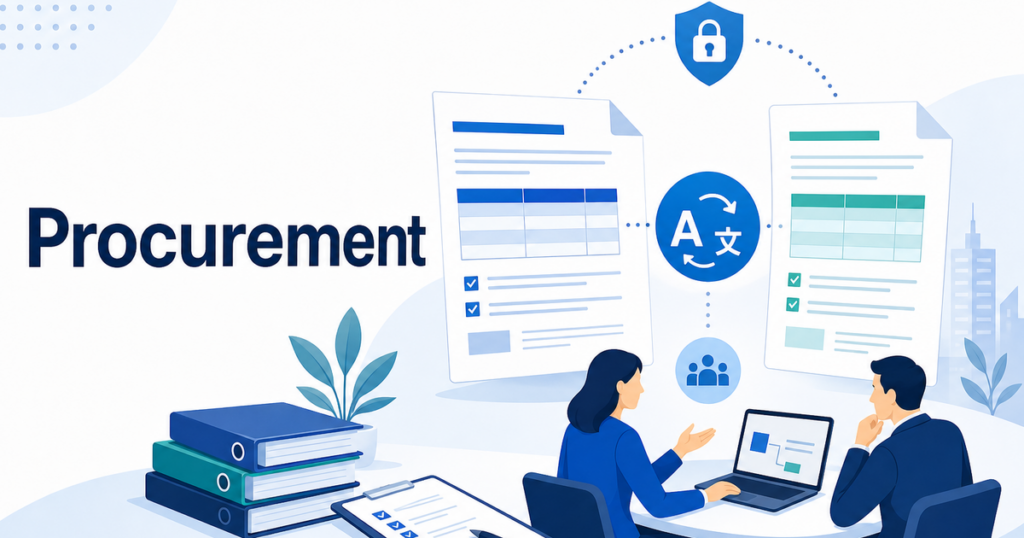

Procurement documents are dense, structured, and high-stakes. A request for proposal, vendor questionnaire, or bid instruction package typically includes tables of requirements, pricing schedules, compliance checklists, and technical specifications. When your suppliers or partners operate in a different language, every one of those elements needs to translate cleanly.
Losing a table row, misaligning a pricing column, or dropping a compliance requirement during translation can delay evaluations, create confusion among bidders, and even expose your organization to risk if contract terms are misunderstood.
This article explains how to translate procurement documents and RFPs while keeping the structure, terminology, and precision that make these documents work.
What Makes Procurement Documents Different
Procurement documents share characteristics that set them apart from general business content:
- Heavy use of tables and matrices: Requirements traceability matrices, evaluation criteria scoring tables, pricing breakdowns, and delivery schedules all depend on precise grid formatting.
- Standardized terminology: Terms like "invitation to bid," "statement of work," "deliverables," and "key performance indicators" have specific meanings in procurement contexts. Translating them loosely can change obligations.
- Referential structure: Sections cross-reference each other constantly. Section 3.2 might reference Appendix C, Table 4. If translation breaks the numbering or heading structure, those references stop making sense.
- Multiple file formats: A single RFP package might include a DOCX narrative, an Excel pricing sheet, a PDF drawing or specification, and a PowerPoint overview. Your translation workflow needs to handle all of them.
These characteristics mean that your translation approach must preserve formatting and structure, not just convert words.
Preparing Procurement Documents for Translation
Consolidate and Organize
Before you translate, make sure your document is in its final form. Last-minute edits after translation begins create version control problems that are expensive to fix in multiple languages.
Check that all tables use actual table formatting in your word processor, not tabs or spaces that look like a table on screen but fall apart when text length changes. Verify that section numbering is consistent and that cross-references point to the correct locations.
Build a Procurement Glossary
Create a list of key terms that must be translated consistently across all documents in the package. This should include:
- Procurement-specific terms unique to your organization
- Product or service names that should not be translated
- Measurement units and currency designations
- Legal and compliance terms that carry specific obligations
- Abbreviations and acronyms used throughout the documents
Even a modest glossary of fifty to one hundred terms significantly improves consistency when you translate multiple related documents.
Identify Non-Translatable Content
Some elements should not be translated at all. These might include proper names of companies or individuals, specific product model numbers, legal entity identifiers, and standards references like "ISO 9001:2015." Mark these clearly so that your translation process leaves them untouched.
Translating Different Parts of an RFP Package
The Narrative Sections
The main body of an RFP or procurement document usually contains the project description, evaluation criteria, submission instructions, and terms and conditions. These sections need careful translation that captures both the meaning and the legal intent.
AI translation tools can produce strong first drafts of these sections. The key is to use a tool that preserves your document formatting, including heading levels, numbered paragraphs, and bulleted lists, so that the structure your evaluators rely on remains intact.
After generating the draft, have a reviewer check the translated terms and conditions section especially carefully. Procurement contracts carry obligations, and a mistranslated clause can shift responsibilities between parties.
Pricing Tables and Spreadsheets
Pricing schedules in Excel format need special attention. The numbers themselves do not change, but column headers, row labels, currency notes, and calculation descriptions all need translation.
When translating Excel files, confirm that your translation tool preserves formulas and cell references. Some tools overwrite formulas with static values during translation, which breaks any calculations your procurement team built into the spreadsheet. Ask your translation provider specifically about formula preservation before processing financial spreadsheets.
Currency formatting is another watch point. If your original document uses comma-separated thousands with a period decimal, and your target language convention uses period-separated thousands with a comma decimal, you need to verify that number formatting has not been accidentally altered during translation.
Also check that conditional formatting rules, data validation dropdowns, and cell comments are handled appropriately. These elements are often overlooked during translation but can affect how the spreadsheet functions.
When translating Excel files, confirm that your translation tool preserves formulas and cell references. Some tools overwrite formulas with static values during translation, which breaks any calculations your procurement team built into the spreadsheet.
Currency formatting is another watch point. If your original document uses comma-separated thousands with a period decimal, and your target language convention uses period-separated thousands with a comma decimal, you need to verify that number formatting has not been accidentally altered during translation.
Technical Specifications and Drawings
Technical specifications often appear as PDF files with embedded diagrams, callouts, and dimension labels. These are among the hardest documents to translate because the text is frequently integrated into the visual layout.
For PDF specifications, look for translation tools that offer OCR capabilities for scanned documents and that can place translated text within the original layout. The goal is to produce a translated specification that your vendors can read alongside the original without confusion about which dimension or tolerance applies.
Bid Instructions and Submission Requirements
These sections tell vendors exactly how to format and submit their responses. Translation errors here can cause vendors to submit incomplete or incorrectly formatted bids, which wastes evaluation time and may require you to issue amendments.
Pay close attention to translated dates, deadlines, and submission formats. A date format that is ambiguous in the target language can cause vendors to miss deadlines. Be explicit about time zones and calendar conventions.
Compliance and Certification Requirements
Many RFPs include sections on required certifications, insurance coverage, regulatory compliance, and similar qualifications. These sections often reference specific standards, regulations, or certification bodies by name.
When translating these sections, ensure that references to standards organizations, regulatory bodies, and certification names are handled correctly. Some references should remain in their original form because they are internationally recognized by their English names. Others may have well-known local equivalents. Your reviewer should verify that compliance references in the translation are recognizable to vendors in the target market.
The Review Process for Translated Procurement Documents
Who Should Review
Procurement document review requires both language expertise and procurement knowledge. Your ideal reviewer is someone who:
- Understands the procurement process and the specific RFP content
- Is fluent in both the source and target languages
- Has experience with contract language and commercial terms
In many organizations, this means pairing a procurement specialist with a bilingual colleague or engaging a local procurement professional who can review both the language and the commercial intent.
What to Check
Structure your review around these priorities:
- Requirements accuracy: Every requirement in the original must appear in the translation. Check section by section, not just by reading through.
- Table integrity: Compare tables side by side. Every row and column should match. Look for wrapped text that might push content into the wrong cell.
- Number consistency: Compare all numbers, including quantities, thresholds, weights, and scoring values. A single digit error in an evaluation weight can change the outcome of a bid comparison.
- Term consistency: Cross-check against your glossary. The same term should be translated the same way every time it appears.
- Reference integrity: Verify that all cross-references point to the correct translated section numbers and appendices.
Coordinating Multilingual Bid Responses
If you are on the vendor side responding to a translated RFP, the challenges are similar but reversed. You receive a procurement document in a language your team may not read natively, and you need to prepare a response that meets all the requirements.
Translate the RFP into your team's working language first so everyone understands the requirements. Then prepare your response in your language and translate it back into the procurement language for submission. This bidirectional translation workflow ensures that both your internal team and the procuring organization can work in the languages they are most comfortable with.
Keep in mind that your translated response becomes part of the official procurement record. Invest the same review effort in the translated response that you would in the original.
Common Problems and Solutions
Broken Table Layouts
When translated text is longer or shorter than the original, tables can overflow or leave awkward gaps. This is especially common when translating from English to languages that use more characters per word.
Solution: Use translation tools that preserve table structure within your original file format rather than extracting text into a flat list and requiring manual reformatting.
Inconsistent Supplier Names
If your RFP mentions the same supplier or product name multiple times, AI translation might render it differently in different places. This creates confusion about whether two names refer to the same entity.
Solution: Include supplier names and product names in your glossary with explicit instructions on whether to translate, transliterate, or leave them as-is.
Mixed File Format Challenges
When your procurement package spans DOCX, Excel, PDF, and PowerPoint, maintaining consistency across formats requires a coordinated approach.
Solution: Process all files through the same translation platform with the same glossary applied. Tools like Jitan Translate that handle multiple file formats under one workflow help keep terminology consistent across your entire package.
For more on how different file formats affect translation quality, see this guide to translating PDFs without losing formatting.
Security and Confidentiality
Procurement documents often contain sensitive commercial information: budget figures, proprietary specifications, vendor evaluations, and strategic sourcing plans. Before uploading these documents to any translation service, verify how the provider handles your data.
Key considerations include:
- Whether documents are stored after translation and for how long
- Whether your content is used to train AI models
- What encryption and access controls protect your files during processing
- Whether you can delete your data from the provider's systems
The FTC's vendor security guidance provides a useful framework for evaluating these questions.
Source: https://www.ftc.gov/business-guidance/small-businesses/cybersecurity/vendor-security
When to Use Professional Translation Services
AI-assisted translation with human review works well for most procurement documents. Consider engaging professional translation services when:
- The procurement is for a regulated industry where translation accuracy may be audited
- The contract value is large enough that a translation error could have significant financial consequences
- The document will be submitted as part of a formal legal proceeding or regulatory filing
- Local law requires translated procurement documents to be produced by a credentialed translator
In these cases, you can still use AI translation to create an internal working copy that speeds up the professional translator's work.
Conclusion
Translating procurement documents and RFPs requires attention to structure, terminology, and consistency across multiple file formats. By preparing clean source documents, building a procurement glossary, using translation tools that preserve formatting, and conducting structured reviews, you can produce translated procurement packages that keep your evaluation process running smoothly.
The investment you make in a careful translation workflow pays off in fewer bidder questions, more accurate responses, and a cleaner evaluation process. Start with your highest-priority procurement, refine your workflow, and scale from there.