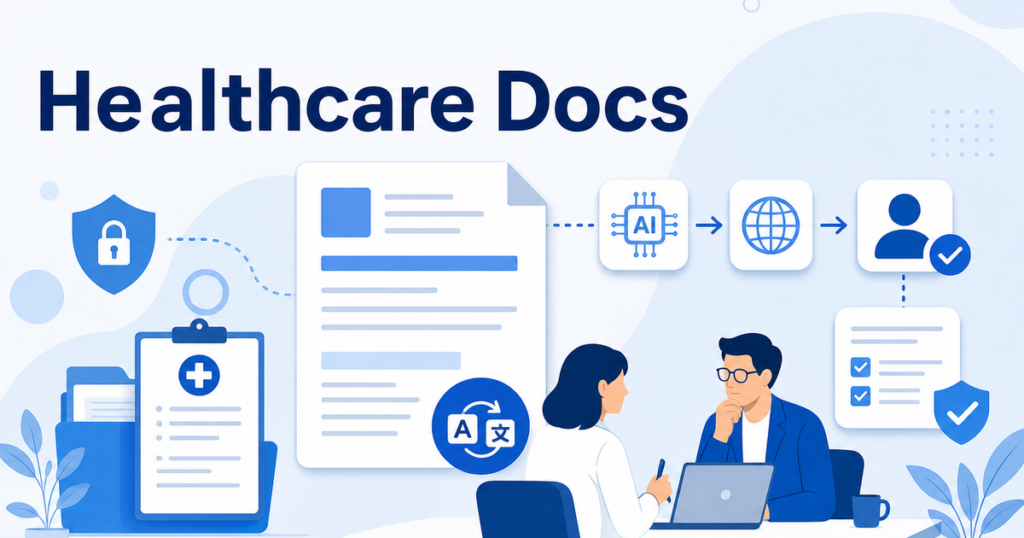
Healthcare document translation sits at the intersection of language access, patient safety, and regulatory compliance. Getting it right matters in ways that go beyond most business translation scenarios, because a mistranslated dosage instruction, consent form, or diagnosis summary can directly affect someone's health.
AI translation tools have made document translation faster and more accessible, but healthcare content demands a level of care that goes beyond what AI can deliver on its own. This article explains what AI translation can and cannot do for healthcare documents, what regulatory frameworks apply, and how to build a workflow that puts patient safety first.
The Healthcare Translation Landscape
Why Healthcare Translation Matters
The U.S. Department of Health and Human Services estimates that millions of Americans have limited English proficiency (LEP), meaning they speak English less than very well. For these individuals, receiving healthcare information only in English creates a barrier to understanding diagnoses, following treatment plans, and making informed decisions about their care.
Source: https://www.hhs.gov/civil-rights/for-individuals/special-topics/limited-english-proficiency/index.html
HHS Section 1557 of the Affordable Care Act prohibits discrimination in healthcare programs and activities, including discrimination based on national origin, which encompasses language. Healthcare providers that receive federal financial assistance are required to take reasonable steps to provide meaningful access to LEP individuals.
Source: https://www.hhs.gov/civil-rights/for-individuals/section-1557/fs-limited-english-proficiency/index.html
Types of Healthcare Documents That Need Translation
Healthcare organizations encounter a wide range of documents that may need translation:
Patient-facing documents:
- Consent forms and informed consent documents
- Discharge instructions and care plans
- Medication guides and dosage instructions
- Patient education materials and health literacy content
- Appointment reminders and follow-up instructions
- Rights and responsibilities notices
Operational documents:
- Clinical protocols and standard operating procedures
- Staff training materials and competency assessments
- Policy and procedure manuals
- Safety data sheets for medical equipment and pharmaceuticals
- Regulatory submissions and compliance documentation
Administrative documents:
- Insurance forms and benefits explanations
- Billing statements and financial assistance applications
- Privacy notices and patient rights summaries
- Quality reports and patient satisfaction surveys
What AI Translation Can Do for Healthcare Documents
Speed and Accessibility
AI translation tools can process documents much faster than human translators. AI translation can produce an initial draft much faster than a manual translation workflow, especially for routine educational materials. This speed is valuable when time-sensitive information needs to reach non-English-speaking patients quickly.
Consistency
AI translation applies the same terminology and phrasing consistently across documents, which helps when translating recurring document types such as standard consent forms or templated discharge instructions. Consistency reduces the risk of patients receiving conflicting information across different documents.
Cost Efficiency
AI-assisted workflows can reduce drafting effort for suitable low-risk materials, but review requirements, privacy controls, and clinical risk determine the real cost. Full human translation may still be appropriate for high-risk content, while AI-assisted drafting can help with lower-risk materials when review is built into the workflow.
Format Preservation
Modern AI document translation tools can translate formatted documents including PDFs, Word files, and other file types while helping preserve document structure. This is important for healthcare documents where formatting carries meaning: tables presenting dosage information, numbered lists of instructions, and highlighted warning boxes all need to maintain their visual structure in the translated version, so reviewers should verify these elements after translation.
What AI Translation Cannot Do for Healthcare Documents
Guarantee Clinical Accuracy
AI translation can produce grammatically correct output that still contains clinically significant errors. A dosage instruction that says "take two tablets daily" might be translated to say "take two tablets twice daily" if the AI misinterprets the source text. These errors are dangerous precisely because the output looks professional and authoritative.
Handle Context-Dependent Medical Language
Medical language is heavily context-dependent. The same abbreviation can mean different things in different specialties. "MS" can mean mitral stenosis in cardiology, multiple sclerosis in neurology, or mental status in emergency medicine. A human translator with medical knowledge recognizes the context; AI may not.
Navigate Cultural Health Beliefs
Patient education materials need to account for cultural health beliefs and practices that vary across communities. A document about managing diabetes that works well for a general American audience may need cultural adaptation for communities with different dietary traditions, health beliefs, or attitudes toward medical authority. AI translation addresses language but not cultural context.
Meet Legal and Regulatory Requirements
Requirements for patient-facing healthcare documents vary by jurisdiction, payer, organization, and document type. AI-only output may be inappropriate for patient-facing or clinical-risk content, so organizations should confirm applicable requirements and build human review into the workflow where needed.
Manage Risk Appropriately
AI translation tools do not understand risk. They cannot distinguish between a casual instruction that can tolerate minor imprecision and a dosage calculation where any error could cause harm. Human reviewers bring this judgment to the process.
Human Review for Patient-Facing Healthcare Content
For healthcare documents, the fundamental principle is clear: AI translation should be treated as a draft tool only, and for patient-facing or clinical-risk content, human review by a healthcare-qualified reviewer is the safer workflow.
Who Should Review
The reviewer should be:
- Fluent in both languages at a professional level
- Knowledgeable about healthcare terminology in both languages
- Familiar with the document type being reviewed (consent forms, discharge instructions, etc.)
- Aware of regulatory requirements for translated healthcare content in the relevant jurisdiction
In many cases, this means a reviewer with healthcare translation experience or a medical interpreter selected according to the organization's requirements, not simply a bilingual staff member.
What the Review Should Cover
- Clinical accuracy. Verify that medical terminology, dosages, and instructions are correct.
- Completeness. Ensure that no information has been omitted from the translation.
- Cultural appropriateness. Check that the content is appropriate for the target community.
- Readability. Verify that the translated content is written at an appropriate reading level. The CDC recommends using plain language for health communication materials.
- Formatting integrity. Ensure that critical visual elements such as dosage tables, warning boxes, and numbered instructions are preserved correctly.
Source: https://www.cdc.gov/health-literacy/php/develop-materials/plain-language.html
Building a Healthcare Document Translation Workflow
Step 1: Classify Documents by Risk
Not all healthcare documents carry the same level of risk when translated. A tiered approach helps allocate review resources appropriately:
Tier 1: High risk. Documents where translation errors could directly harm patients. Examples: medication instructions, dosage tables, informed consent forms, allergy information, surgical preparation instructions. For these documents, a safer workflow is AI-assisted drafting followed by review by a healthcare-qualified reviewer and clinical review where appropriate.
Tier 2: Moderate risk. Documents where translation errors could cause confusion or non-compliance but are unlikely to cause direct harm. Examples: general patient education materials, appointment instructions, dietary guidelines. These should usually receive AI-assisted drafting followed by review by a bilingual healthcare professional.
Tier 3: Low risk. Documents where translation errors would be inconvenient but not dangerous. Examples: facility maps, parking instructions, general information about visiting hours. These may use AI translation with spot-check review.
Step 2: Build a Medical Terminology Glossary
Create a glossary of key medical terms with their approved translations in each target language. This glossary should include:
- Common medical conditions and their standard translations
- Medication names (brand and generic) and whether to translate or keep in English
- Dosage terminology and unit conventions
- Anatomical terms
- Procedure names
- Abbreviation mappings
This glossary ensures consistency across all translated documents and reduces the risk of terminology errors.
Step 3: Establish Review Protocols
Document the review process for each tier:
- Who reviews: Specify the qualifications required for reviewers at each tier
- What they check: Provide a checklist specific to healthcare document review
- How long it takes: Set expectations for turnaround time based on document complexity and tier
- How issues are resolved: Define the process for handling disagreements between the AI translation and the reviewer's preferred translation
Step 4: Manage Versions and Updates
Healthcare documents are updated regularly as clinical guidelines change, new medications are introduced, and regulations are revised. Maintain a version control system that links each translated document to the specific version of the source document it was translated from.
When a source document is updated, the corresponding translation must be reviewed and updated as well. This is particularly important for consent forms and dosage instructions, where outdated information could be harmful.
Step 5: Track Quality Over Time
Implement a quality tracking system that records:
- Types of errors found during review
- Frequency of errors by document type and language pair
- Time required for review at each tier
- Feedback from patients and staff on translated materials
This data helps you identify patterns, refine your glossary, improve source document clarity, and adjust your workflow over time.
Regulatory Considerations
Federal Requirements
The HHS Office for Civil Rights enforces Section 1557, which requires covered healthcare entities to provide language assistance to LEP individuals. This includes translating vital documents into languages spoken by a significant portion of the patient population.
Source: https://www.hhs.gov/civil-rights/for-individuals/section-1557/fs-limited-english-proficiency/index.html
What constitutes a "vital document" varies by context but typically includes consent forms, discharge instructions, notices of rights, and other documents that patients need to understand for their care.
State Requirements
Many states have additional language access requirements for healthcare providers. These may specify which languages require translation, what types of documents must be translated, and what qualifications translators must hold. Check your state's specific requirements.
Accreditation Standards
Healthcare organizations accredited by bodies such as The Joint Commission may have additional requirements for language access and translated materials. These standards often align with federal requirements but may include additional specifications.
Risk Management
What Can Go Wrong
Healthcare translation errors fall into several categories:
- Dosage errors. Translating "1 tablet" as "10 tablets" or "daily" as "twice daily" can lead to overdose or underdose.
- Allergy errors. Mistranslating allergy information can result in a patient receiving a medication they are allergic to.
- Consent errors. If a patient does not truly understand what they are consenting to, the consent may not be valid.
- Instruction errors. Mistranslated preparation instructions for procedures such as colonoscopies or surgeries can result in procedures being delayed or performed without adequate preparation.
Mitigation Strategies
- Always use the tiered review process. Never distribute AI-translated healthcare content without human review appropriate to the tier.
- Test with real patients. After translated materials are reviewed and approved, test them with a small group of patients from the target language community to identify comprehension issues.
- Maintain feedback channels. Give patients and staff a way to report confusing or potentially incorrect translated content.
- Review regularly. Even approved translations should be periodically reviewed for accuracy, especially when source documents are updated.
Practical Recommendations
- Start with your most critical patient-facing documents. Consent forms, discharge instructions, and medication guides should be the first documents you translate through a rigorous workflow.
- Invest in qualified reviewers. The quality of your translated healthcare content ultimately depends on the quality of your reviewers. Consider healthcare-qualified reviewers or translators with medical translation experience for high-risk content.
- Write source documents for translation. Clear, simple, unambiguous English source documents translate better. Follow plain language guidelines from the CDC when creating healthcare content that will be translated.
- Use AI as a productivity tool, not a replacement. AI translation reduces the cost and time of producing initial drafts, making it feasible to translate more content. But it does not replace human expertise in healthcare contexts.
- Document your process. In the event of a patient safety incident involving translated materials, being able to demonstrate a rigorous translation and review process is important for risk management.
The Bottom Line
AI translation has a valuable role to play in healthcare document translation. It makes it feasible to translate more content, faster, and at lower cost than human translation alone. But in healthcare, speed and cost can never come at the expense of accuracy and patient safety.
The responsible approach is to use AI translation as a draft tool, classify documents by risk level, involve reviewers with appropriate healthcare knowledge where the content affects patients, and maintain rigorous quality processes. This approach expands language access while maintaining the standards that patient safety demands.
Healthcare teams that embrace this balanced approach can serve LEP patients more effectively, reduce compliance risk, and build trust with multilingual communities. The technology is a means to that end, not the end itself.