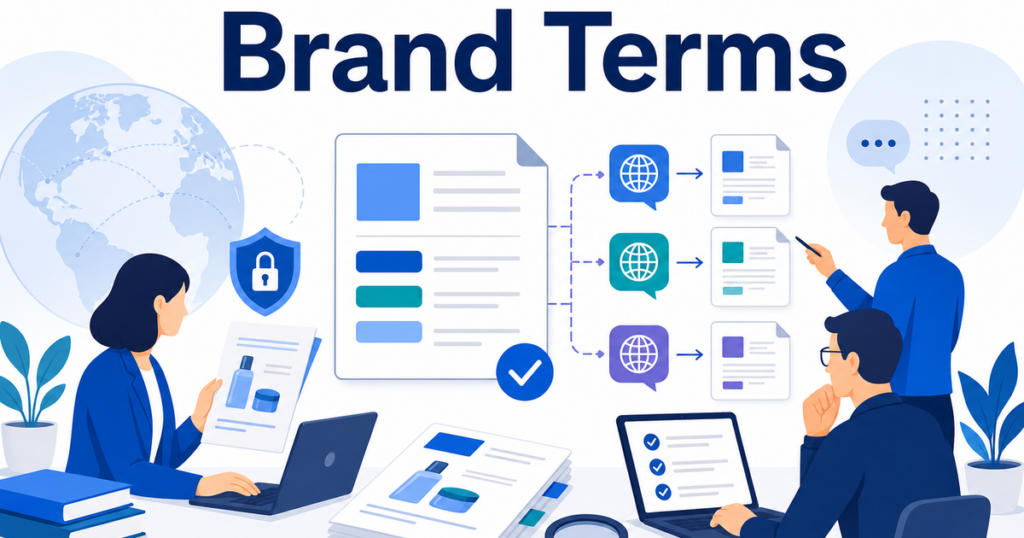

Your company just finished a 50-page product catalog. It is packed with brand names, product series, feature labels, and trademarked terms. Now it needs to be translated into three languages. What happens to all those names?
This is one of the most overlooked problems in document translation. Get it right, and your translated documents reinforce your brand globally. Get it wrong, and you end up with product names that mean something embarrassing in another language, inconsistent terminology across documents, and a brand identity that falls apart the moment it crosses a language border.
Here is how to handle brand terms and product names in translated documents.
The Core Problem
Brand terms and product names sit in a gray zone between "translate" and "do not translate." Some terms should stay exactly as they are in every language. Others need adaptation. And the rules are different for every company and every market.
Terms That Should Not Be Translated
Most registered trademarks and established brand names should remain untranslated. "iPhone" is "iPhone" in every language. "Salesforce" is "Salesforce" worldwide. Translating these terms dilutes the brand and can cause legal issues with trademark protection.
Terms That Need Adaptation
Some product names and taglines need adaptation for the target market. This is not a casual decision — it requires linguistic and cultural analysis. A product name that works in English may have negative connotations in another language, or it may be unpronounceable for the target audience.
Terms That Are Ambiguous
The hardest category: terms that sometimes need translation and sometimes do not. A feature name like "Dashboard" might be kept in English in some markets (where the English term is widely understood) and translated in others (where the local term is preferred). These decisions need to be made case by case and documented.
Step 1: Build a Terminology Database
Before you translate a single document, create a terminology database. This is a structured list of every brand term, product name, feature label, and trademarked term in your content, along with rules for how each should be handled in translation.
What to Include
For each term, document:
- The term itself as it appears in source content.
- The rule: Keep as-is, translate, or adapt.
- The approved translation (if applicable).
- Context notes: Where the term appears, how it is used, any restrictions.
- The target language (rules may differ by language).
- The source: Who decided this rule and when.
Example Entry
- Term: "CloudSync Pro"
- Rule: Keep as-is in all markets
- Translation: N/A
- Context: Product name, registered trademark. Always capitalize both words. Never hyphenate.
- Decision by: Marketing team, January 2026
Another example:
- Term: "Getting Started Guide"
- Rule: Translate
- Translation (Japanese): "Getting Started Guide" (keep English)
- Translation (German): "Erste Schritte"
- Context: Document title. Translation varies by market based on brand guidelines.
- Decision by: Localization team, March 2026
Who Owns the Terminology Database
Assign clear ownership. Marketing usually owns brand names and taglines. Product teams own feature names. Legal owns trademark usage rules. The localization or translation team manages the database itself but sources decisions from these stakeholders.
Step 2: Configure Your Translation Tools
Once you have a terminology database, configure your translation tools to enforce it. This is where most teams fall short — they build the glossary but do not connect it to the tools that actually do the translation.
AI Translation Glossaries
If you use AI translation, load your terminology as a custom glossary. Major platforms support this:
- DeepL: Multilingual glossaries let you specify how terms should be handled. The engine applies these rules during translation.
Source: DeepL multilingual glossaries
- Google Cloud Translation: Custom glossaries work similarly, allowing you to define term-level rules.
Source: Google Cloud Translation glossaries
- Azure AI Translator: Custom translation and terminology features let you control how specific terms are handled.
Source: Azure AI Translator overview
Human Translation Briefs
If you use human translators, include the terminology database as part of every translation brief. Do not assume translators will know your brand rules. Explicitly state which terms to keep and which to translate, and provide the approved translations.
Document Translation Platforms
Platforms like Jitan Translate handle the translation of business documents — PDF, DOCX, PPTX, XLSX — with layout preservation designed to keep formatting intact. When used as part of a workflow that includes glossary-configured AI engines, they produce translated documents where the layout generally stays consistent and your brand terms are handled according to your rules. Review is recommended for complex layouts.
Step 3: Handle Special Cases
Brand term translation is full of edge cases. Here are the most common ones and how to handle them.
Product Names in Running Text
When a product name appears in a sentence, the surrounding grammar may need to change in the target language. "CloudSync Pro helps you manage files" might translate to a structure where the product name sits in a different position. Work with your translators to ensure the surrounding text accommodates the product name naturally.
Abbreviations and Acronyms
Decide whether abbreviations stay in English or are translated. "API" is often kept as-is globally. "ROI" might be translated in some languages. Document the rule for each abbreviation.
Legal Disclaimers and Trademark Notices
Legal text has specific requirements around trademark usage. The circle-R symbol, "TM" designations, and trademark attribution lines may need to stay in English even when surrounding text is translated. Consult your legal team for guidance.
UI Labels and Screenshots
If your document contains screenshots of your product's interface, the UI labels in those screenshots may need localization. This often requires separate screenshot localization — translating the UI, taking new screenshots, and embedding them in the document. Plan for this as a separate task.
Placeholder Text and Variables
Documents often contain variables like {{product_name}} or %company_name% that get replaced dynamically. These must be excluded from translation entirely. Make sure your translation tools recognize and preserve placeholders.
Step 4: Review for Terminology Compliance
After translation, do a terminology compliance review. This is separate from a general quality review and focuses specifically on whether your brand terms were handled correctly.
Automated Terminology Checking
Some translation tools can automatically compare the translated output against your glossary and flag any discrepancies. This catches cases where the AI engine or translator changed a term that should have been kept as-is.
Manual Spot-Check
Even with automated checking, do a manual spot-check of key terms. Automated tools may miss context-dependent issues — a product name that should be kept in most contexts but translated in a specific type of content.
Brand Team Sign-Off
For high-visibility documents, have your marketing or brand team review the translated document specifically for brand term usage. They will catch issues that a general translator or editor might miss because they know the brand standards intimately.
Common Mistakes
Inconsistent Treatment Across Documents
The marketing team keeps "CloudSync Pro" untranslated in the product brochure, but the support team translates it in the knowledge base. Customers see two different names for the same product and get confused. This happens when there is no centralized terminology database and each team makes its own decisions.
Translating Terms That Should Stay
Some translators — both human and AI — translate product names by default because that is their job. Without explicit instructions to keep certain terms untranslated, they will translate everything, including terms that should stay in the original language.
Forgetting to Update the Glossary
Your company rebrands a product. The old name is in the glossary. Every new translation uses the old name because no one updated the glossary. Review and update your terminology database whenever products are renamed, rebranded, or discontinued.
Not Testing in Context
A term that looks fine in a glossary spreadsheet might read awkwardly in the middle of a sentence in the target language. Test key terms in context by reviewing them in actual translated content, not just in isolation.
Scaling Terminology Management
As your organization grows, terminology management needs to scale with it. Here are strategies for managing terminology across a growing team:
- Centralize the database: Use a shared tool — a spreadsheet works for small teams, a terminology management system for larger ones. The key is a single source of truth that everyone references.
- Integrate with translation workflows: Make the glossary a mandatory input for every translation project, whether AI or human.
- Assign ownership: One person or team should own the glossary and be responsible for updates. Distributed ownership leads to conflicts and inconsistencies.
- Review quarterly: Set a recurring calendar event to review the glossary. Remove obsolete terms, add new products, and update rules based on market feedback.
- Collect feedback from translators: Translators are on the front lines of terminology issues. Create a channel for them to flag problems and suggest improvements.
The Payoff
Investing in terminology management pays off in three ways:
- Brand consistency: Your products are called the same thing in every market, in every document, across every team.
- Translation quality: Translators and AI engines produce better output when they have clear rules to follow.
- Cost efficiency: Less rework from terminology errors means lower translation costs over time.
The upfront investment in building a terminology database is modest — a few hours for most organizations. The ongoing maintenance is light — a review every quarter and updates when products change. The return is significant and cumulative.
Terminology and Different File Formats
Brand term handling varies by document format, and this adds complexity that teams often overlook until they encounter problems.
PowerPoint Considerations
In PowerPoint files, product names often appear in slide headers, callout boxes, diagrams, and embedded charts. Some of these elements are grouped or positioned in ways that make them difficult for translation tools to process correctly. Verify that your translation tool handles grouped objects and text boxes properly, especially when product names need to remain untranslated while surrounding text is translated.
Excel Considerations
In Excel, product names frequently appear in column headers, pivot table labels, and named ranges. If your translation tool accidentally translates a product name that is also used as a named range reference, formulas will break. Test your tool on a small spreadsheet before processing large financial models or data tables.
PDF Considerations
PDF files add another layer of complexity because the text layout is fixed. When a product name is kept untranslated but the surrounding text expands or contracts in the target language, the layout may need adjustment. Document translation platforms that specialize in layout preservation are designed to reflow text around fixed elements, though results vary by document complexity.
Real-World Terminology Management Example
Consider a software company that sells a product called "DataVault" in 12 markets. In 10 of those markets, the name stays in English. In Japan, the marketing team decided to use a localized name. In Brazil, the legal team required a Portuguese trademark registration under a different name.
The terminology database captures all three rules. When the translation tool encounters "DataVault," it checks the glossary and applies the correct treatment based on the target language. Without the glossary, the AI engine might translate "DataVault" literally in Japanese and Portuguese, creating inconsistency with established brand usage in those markets.
This example illustrates why terminology management is not just about preventing errors. It is about enforcing deliberate brand decisions that vary by market.
For practical guidance on choosing a translation platform that supports your terminology workflow, this article on translating PDFs without losing formatting covers what to look for in document translation tools.