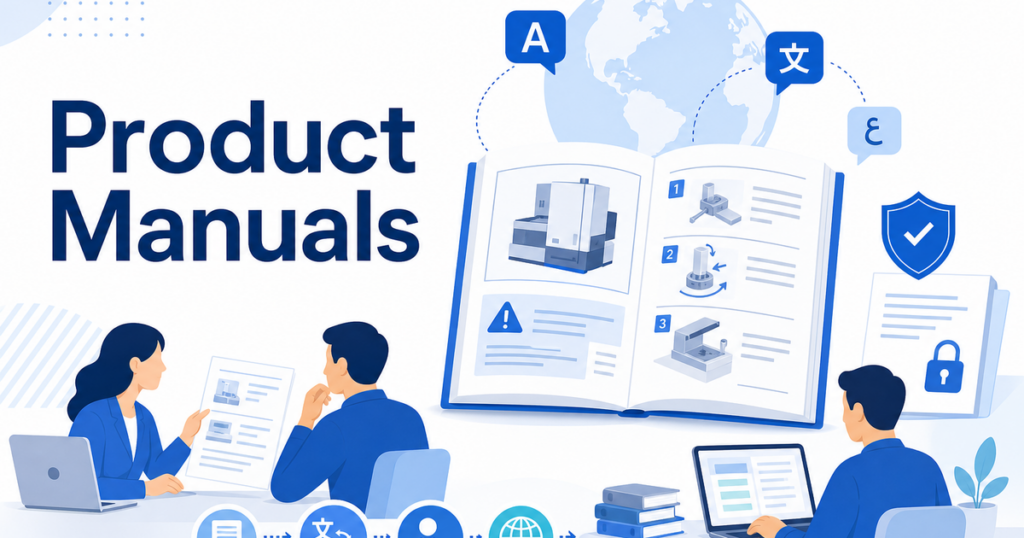

Product manuals are often the first detailed interaction a customer has with your product after purchase. When that manual is only available in a language the customer does not read well, the experience suffers from the start. Assembly goes wrong, features go undiscovered, and support calls increase.
Translating product manuals for international customers requires more than swapping words. It demands careful handling of safety warnings, technical illustrations, version tracking, and regulatory considerations. This article explains how to approach product manual translation in a way that serves your customers and protects your business.
Planning Your Manual Translation Strategy
Which Manuals to Translate First
If you have a product line with multiple manuals, prioritize based on:
- Sales volume by market: Start with products that have the highest international sales or the most demand for translated documentation.
- Complexity of assembly or operation: Products that require precise assembly or have many operating modes benefit most from translated instructions.
- Regulatory requirements: If a market requires documentation in the local language, those translations are not optional.
- Support burden: If your support team fields many questions from non-English-speaking customers about a particular product, translating that manual may reduce support costs.
Choosing the Right File Format
Most product manuals are produced in DOCX or PDF format. Some companies also use PPTX for quick-start guides or single-page instruction sheets.
DOCX is generally the best format for translation because the text flows naturally and formatting is stored as structural markup. If your manual was designed in a desktop publishing tool that exports to PDF, consider whether you can also export to DOCX for translation purposes. The DOCX-to-PDF conversion after translation often produces better results than translating the PDF directly.
For detailed guidance on format-specific challenges, see this guide to translating PDFs without losing formatting.
Why Product Manual Translation Matters
A product manual serves several functions at once. It teaches the customer how to use the product safely and effectively. It documents warranty terms and support options. And in many markets, it fulfills a regulatory requirement for providing documentation in the local language.
When the manual is not available in the customer's language, the consequences extend beyond frustration. Misunderstood safety warnings can lead to injury or property damage. Incorrect assembly instructions can damage the product. Missing regulatory information can create compliance issues in certain markets.
Investing in product manual translation is not just a customer experience improvement. It is a risk management decision.
Types of Content in Product Manuals
Product manuals contain a mix of content types, each with different translation requirements:
Safety Warnings and Precautions
Safety content is the highest-priority element in any product manual. Warnings about electrical hazards, chemical exposure, choking risks, or mechanical dangers must be translated with absolute precision. A safety warning that loses its urgency or specificity in translation can create liability exposure and, more importantly, real danger to users.
Safety content should be reviewed by someone with knowledge of local safety documentation standards. Many regions have specific formatting requirements for safety warnings, including the use of signal words like "DANGER," "WARNING," and "CAUTION" and their equivalents in the target language.
Assembly and Installation Instructions
Step-by-step assembly instructions combine text with illustrations, numbered sequences, and reference letters or numbers that point to specific parts. The translation must maintain the alignment between the text and these visual references.
If step 3 says "Insert bolt B into hole C as shown in Figure 4," the translated version must preserve the correspondence between bolt B, hole C, and Figure 4. If translation shifts figure numbering or changes reference labels, the instructions become impossible to follow.
Operating Procedures
Operating instructions explain how to use the product's features. These sections often include descriptions of control panels, menu structures, and indicator lights. When the product interface has been localized, the manual should reference the translated interface labels. When it has not, the manual should clearly state that interface elements appear in English.
Troubleshooting Guides
Troubleshooting sections help customers diagnose and resolve common problems. They use conditional logic: "If the light blinks red, check X. If it blinks green, check Y." This logical structure must translate cleanly. A mistranslated "if" or "unless" can send a customer down the wrong diagnostic path.
Specifications and Technical Data
Technical specifications, including dimensions, capacities, electrical ratings, and performance data, consist largely of numbers and units. These sections need careful review to ensure that number formatting, decimal separators, and unit conventions match the target market's standards.
Warranty and Legal Notices
Warranty terms and legal disclaimers appear at the end of most product manuals. While AI translation can produce drafts of this content, warranty and legal language should receive careful review. Note that machine translation of legal content does not constitute legal advice, and any warranty claims processes described in the manual need to function correctly in the target market.
Environmental and Disposal Information
Many products require environmental and disposal information, including recycling instructions, material composition disclosures, and end-of-life disposal guidelines. These sections may be subject to local environmental regulations and need to reference the correct local standards and authorities in the translated version.
Preparing Your Manual for Translation
Design for Translation from the Start
If you are creating a new product manual, build translation readiness into your design process:
- Leave white space: Translated text is often longer than the original. Tight layouts leave no room for text expansion.
- Use editable graphics: Create diagrams in tools that allow text editing rather than flattening text into image files.
- Separate text from images: Where possible, use callout numbers on diagrams and provide translations in a legend rather than embedding text directly in illustrations.
- Use standard fonts: Choose fonts that support a wide range of character sets so you do not need to change fonts for different language versions.
Organize Your Source Files
Have clean, final source files ready before translation begins. If your manual is in DOCX format, ensure styles are applied consistently. If it is in PDF format, verify that the PDF was generated from a text-based source rather than scanned from paper.
For a closer look at how different formats affect the translation process, see this guide to translating PDFs without losing formatting.
Create a Product Glossary
Compile a glossary of terms specific to your product. This should include:
- Product name and model numbers
- Feature names and their approved translations
- Part names used in assembly instructions
- Technical specifications and their units
- Safety signal words and their standard translations in each target language
The Translation Process
Step 1: Translate the Main Body
Upload your product manual to a translation tool designed to preserve formatting. Tools like Jitan Translate support DOCX, PDF, and PPTX formats, which cover most product manual file types. The translation engine aims to produce a draft that maintains your document's layout, including tables, numbered lists, and image placement, though review is recommended.
Step 2: Handle Visual Elements
Review all visual elements in the translated manual:
- Diagrams with text labels: Determine whether to translate the labels in place or use numbered callouts with a translated legend.
- Screenshots: If your product has a localized interface, retake screenshots in the target language. If not, add a note to the manual explaining that screenshots show the English interface.
- Warning symbols and icons: Verify that safety icons are recognized in the target market. Some symbols have different recognition levels across cultures.
Step 3: Conduct a Technical Review
Have the translated manual reviewed by someone who:
- Is fluent in the target language
- Has used or is familiar with the product
- Understands local regulatory requirements for product documentation
The reviewer should follow the translated instructions step by step with the actual product if possible. This practical review catches errors that reading the text alone would not reveal, such as a translated instruction that says "turn left" when the product requires turning right.
Step 4: Verify Safety Content
Safety warnings deserve a dedicated review pass. Check that:
- Signal words are translated using the standard conventions for the target market
- Warning content accurately reflects the original safety information
- Formatting matches local requirements for safety documentation
- Nothing in the translation softens or qualifies the original warning
Step 5: Customer-Facing Review
Before finalizing, have someone unfamiliar with the translation process read the manual as a customer would. This fresh-eyes review catches issues like missing steps, unclear references, or jargon that the target audience would not understand.
Version Control for Translated Manuals
Product manuals are tied to specific product versions. When the product is updated, the manual needs to be updated too, and the translated versions need to keep pace.
Establish a version control system that tracks:
- Which product version each manual corresponds to
- Which translation version corresponds to which source version
- When each translation was last updated
- Who reviewed each version
Simple practices like including the product version number on the manual's cover page and in the file name, such as "ProductX-Manual-v2.1-JA.pdf," prevent confusion about which manual applies to which product version.
When the product changes, identify which sections of the manual are affected. Often, a product update changes only a few pages, and you can translate just the updated sections rather than retranslating the entire manual.
Managing Multiple Languages
If you are translating your manual into several languages simultaneously, coordinate the process carefully:
- Translate from the same source version for all languages
- Use the same translation tool and glossary for all languages to ensure consistency
- Have all reviewers work from the same review checklist
- Stagger review timelines so you can incorporate learnings from earlier reviews into later ones
This coordination prevents the common problem of having different language versions that are based on different source versions, which creates support confusion when customers in different markets report different instructions.
Regulatory Considerations
Depending on your product and target market, there may be regulatory requirements for product documentation:
- Some markets require product manuals in the local language as a condition of sale
- Certain product categories, such as electrical equipment, children's products, or industrial machinery, have specific documentation requirements
- Safety warnings may need to follow prescribed formats defined by local standards bodies
AI translation can help you produce the content, but compliance with local documentation requirements is your responsibility. Check the specific requirements for each market before distributing translated manuals.
Working with Local Distributors and Partners
If you sell through local distributors or partners, involve them in the translation review process. They know the market, the customers, and the regulatory environment. Their feedback on translated manuals can identify issues that your internal reviewers would miss.
Local partners can also help with market-specific adjustments that go beyond translation. For example, a manual might reference a customer support phone number that is only available in certain countries, or a warranty return address that differs by region. These localization details ensure the translated manual is not just linguistically accurate but also practically useful for customers in that market.
Conclusion
Translating product manuals for international customers requires attention to safety content, visual elements, version control, and local requirements. By designing manuals with translation in mind, maintaining a product-specific glossary, conducting thorough technical reviews, and implementing version tracking, you can produce translated manuals that help your customers use your products safely and effectively.
Start with your highest-volume or highest-risk products, refine your process, and expand to your full product line. Your international customers, and your support team, will benefit from manuals they can actually understand.