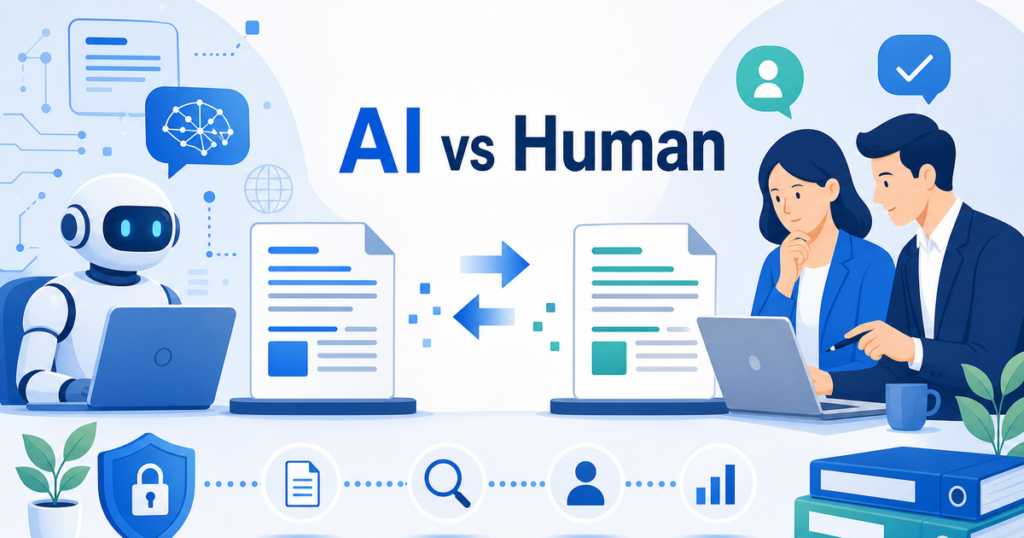
The question is not whether AI translation is good enough. It is whether it is good enough for *this specific document, for this audience, at this moment.* AI handles more translation work every year, but human translators still have a clear role in business workflows. The trick is knowing when to use which.
This article breaks down real-world scenarios so you can make that decision with confidence instead of guessing.
Where AI Document Translation Excels Today
AI translation has improved dramatically over the past few years. Neural machine translation engines produce fluent, readable output for many language pairs and document types. For common business content — internal memos, project updates, knowledge base articles — AI translation often produces results that are perfectly usable with minimal editing.
The speed advantage is significant. AI can often produce a draft much faster than a human translator, especially for long internal documents. A human translator needs days for the same volume. For time-sensitive content, that difference is not a convenience. It is the difference between communicating and not communicating.
Cost follows the same pattern. AI translation costs a fraction of human translation per word. When you are translating thousands of pages of documentation, that gap adds up to real budget impact.
Documents That Work Well With AI
Internal communications, technical documentation, training materials, user guides, product specifications, knowledge base articles, meeting notes, email drafts — these are all strong candidates for AI translation. They tend to use straightforward language, follow predictable structures, and have audiences who can tolerate minor imperfections.
Large-volume projects also favor AI. If you need to translate 200 product descriptions or 500 support articles, AI gives you a baseline that a human editor can then review and correct, which is far more efficient than translating everything from scratch.
Where Human Translation Still Wins
Human translators bring three things that AI still struggles with: context judgment, cultural adaptation, and creative quality.
High-Stakes Legal and Financial Content
Contracts, regulatory filings, patent applications, financial statements, and compliance documents carry real risk if a word is wrong. The legal and financial consequences of a mistranslation in a merger agreement or a regulatory submission can be severe. Human translators with domain expertise understand not just the words but the legal weight behind them.
AI can produce a first draft of a contract translation, and that draft may save time. But the final version of any document with legal or financial significance should be reviewed by a qualified human translator.
Marketing and Brand Content
Marketing translation — often called transcreation — requires cultural adaptation that goes beyond word-for-word accuracy. A slogan that works in English may fall flat or cause offense in another language. Nuance, tone, humor, and cultural references all need human judgment.
Product launch materials, brand campaigns, website copy aimed at customers, and advertising content all benefit from human translators who understand the target culture and can adapt the message, not just translate the words.
Customer-Facing Content With Brand Voice
When your document represents your brand directly — proposals, executive communications, customer-facing reports — the quality bar rises. Minor awkwardness in an internal memo is forgivable. In a client proposal, it undermines credibility. Human translators ensure the final output matches your brand voice and reads naturally in the target language.
The Decision Framework
Instead of treating this as an all-or-nothing choice, think of it as a spectrum. Here is a practical framework for deciding.
Step 1: Classify the Document by Risk and Visibility
Ask two questions about every document:
- What happens if the translation contains an error? (Risk)
- Who will read this? (Visibility)
A high-risk, high-visibility document — a contract, a press release, a regulatory filing — needs human translation or at minimum human review. A low-risk, low-visibility document — an internal process update, a draft project plan — can go straight to AI.
Most documents fall somewhere in the middle. A product manual is high-visibility but moderate-risk. An internal policy update is low-visibility but could be high-risk if it contains safety information.
Step 2: Consider the Language Pair
AI translation quality varies significantly by language pair. English-to-Spanish, English-to-French, English-to-German, and English-to-Chinese are generally strong. Less common pairs may produce noticeably lower quality.
If you are translating between two less common languages, or if the content uses a lot of domain-specific jargon, human translation becomes more important regardless of the risk level.
Step 3: Factor In Timeline and Budget
Be honest about your constraints. If you need 200 pages translated by Friday and your budget is limited, AI translation with selective human review on the most critical sections is your realistic option. If you have two weeks and adequate budget, full human translation may be feasible.
Do not let budget constraints push you toward AI for high-risk documents without a review step. A poorly translated contract is more expensive than a properly translated one.
The Hybrid Approach: AI Draft Plus Human Review
The most cost-effective workflow for most business content is a hybrid approach. AI produces the first draft. A human translator reviews, corrects, and polishes the output. This is called machine translation post-editing, and it has become standard practice in the translation industry.
Light Post-Editing
For internal documents and content where minor imperfections are acceptable, a human reviewer does a quick pass to catch obvious errors, check terminology, and fix anything that reads unnaturally. Light post-editing can take less time than translating from scratch, but the actual savings depend on language pair, content complexity, and reviewer standards.
Full Post-Editing
For client-facing or externally published content, the reviewer does a thorough edit — checking meaning, tone, formatting, and cultural appropriateness. This takes significantly less time than a full human translation from scratch, though the exact ratio depends on the content domain and quality expectations.
The hybrid approach gives you most of the speed and cost savings of AI while maintaining the quality floor that human oversight provides.
Common Mistakes to Avoid
Assuming AI Is Always Good Enough
AI translation quality has improved, but it is not uniform. A legally binding document translated by AI without review can create real liability. A culturally insensitive translation in a marketing piece can damage your brand. Always match the quality approach to the document's risk and visibility.
Assuming Human Translation Is Always Necessary
On the other end, some organizations default to human translation for everything, including internal documents that no customer will ever see. This wastes budget and slows down internal communication. Use AI for what it handles well, and reserve human expertise for where it truly adds value.
Skipping the Review Step
If you use AI translation for anything external, have at least one human review the output before publishing. Unreviewed AI translation is the most common source of embarrassing translation errors in business content.
Not Maintaining a Glossary
Whether you use AI, human, or hybrid translation, maintain a glossary of key terms — product names, brand terms, technical vocabulary. Both AI engines and human translators produce better, more consistent results when they have a glossary to reference.
How Dedicated Translation Platforms Help
Document translation platforms like Jitan Translate can serve as the AI translation layer in this framework. They handle the file formats businesses actually use — PDF, DOCX, PPTX, XLSX — and are designed to preserve layout and formatting, which helps reduce formatting cleanup after translation. However, review is recommended for complex layouts.
For teams using a hybrid workflow, these platforms produce AI-translated documents that a human reviewer can then open, edit, and finalize, generally with less formatting repair than a manual process would require.
Measuring Translation ROI
To make informed decisions about where to invest in AI versus human translation, track the return on investment:
- Cost per translated word for AI-only, human-only, and hybrid approaches. The hybrid approach typically lands between the two but delivers quality closer to human translation.
- Time to publish for each approach. AI translation can reduce turnaround from days to hours, which has downstream effects on project timelines and time-to-market.
- Error rates by translation method. Track how many corrections are needed per page for each approach, and whether those corrections are accuracy issues (serious) or style preferences (minor).
- Stakeholder satisfaction scores. Survey the people who use the translated documents. Their perception of quality is the metric that ultimately matters.
Use these measurements to refine your tier system over time. If AI translation quality improves for a particular language pair, you may be able to move some document types from Tier 3 to Tier 2, reducing costs without sacrificing quality.
Real-World Scenarios
Scenario 1: Translating Employee Handbooks
An employee handbook is high-visibility (every employee reads it) and high-risk (it contains policies with legal implications). The best approach is AI translation to produce a draft, followed by full post-editing by a human translator with employment law knowledge in the target country.
Scenario 2: Translating Internal Project Documentation
A 100-page technical specification for an internal engineering team is low-visibility and moderate-risk. AI translation alone may be sufficient, with a quick review by a bilingual team member to check technical terms.
Scenario 3: Translating a Client Proposal
A 30-page proposal going to a prospective client is high-visibility and high-risk (a poor translation could lose the deal). Full human translation is the safest choice here, or AI with extensive post-editing if timeline demands it.
Scenario 4: Translating 500 Product Descriptions
Volume is the defining factor. AI translation for all 500, with selective human review on a sample to identify systematic errors, is the practical approach. Once you spot patterns, you can correct them globally using a glossary or find-and-replace.
Scenario 5: Translating a Safety Manual
A factory safety manual contains procedures that, if misunderstood, could cause physical harm. This is moderate-visibility but high-risk content. AI translation can produce the initial draft, but the final version needs review by someone with both language expertise and knowledge of workplace safety regulations in the target country. The cost of a translation error here is not just reputational — it could be physical.
The Role of Context in Translation Quality
One factor that often gets overlooked in the AI vs human discussion is context. AI translation engines translate sentence by sentence. They do not always carry context from one paragraph to the next, and they certainly do not understand the broader business context behind a document.
A human translator reads the entire document before starting. They understand that the "product" referred to on page 3 is the same "solution" mentioned on page 12. They know that the tone should be formal in the legal section but conversational in the introduction. This contextual understanding is something AI is improving at but has not fully achieved.
For documents where context matters — long reports, policy documents, anything with cross-references — human review after AI translation provides the contextual correction that pure AI misses.
Building Your Translation Strategy
Instead of deciding project by project, build a translation strategy that covers all your content types. Classify your documents into tiers: Tier 1 for AI-only (internal, low-risk), Tier 2 for AI plus light review (moderate visibility), and Tier 3 for human translation or full post-editing (external, high-risk). Document this classification so your team knows which tier each document type falls into.
This removes the decision burden from individual team members and ensures consistent quality treatment across the organization. Revisit your tier assignments every six months as AI quality improves.
Final Guidance
The AI vs human translation debate is over in principle. AI handles the volume. Humans handle the judgment. The practical question is where to draw the line for each document, and that line depends on risk, visibility, language pair, timeline, and budget.
Start with AI for everything. Add human review where the stakes justify it. Maintain a glossary to improve consistency across both approaches. And revisit your decisions as AI quality continues to improve.
If you are looking for an AI document translation tool that handles Office formats and preserves your layouts, this guide to translating PDFs without losing formatting covers what to look for in a translation platform.