
Human resources policies set the rules your employees follow every day. When your workforce spans multiple languages, those policies need to reach everyone clearly. A single misunderstood safety rule or benefits clause can create confusion, compliance gaps, and even legal exposure.
AI-assisted translation has changed how teams approach this work. Instead of sending every document to a translation agency and waiting days, HR departments can now generate first drafts in minutes and focus their energy on what matters most: making sure the meaning is right.
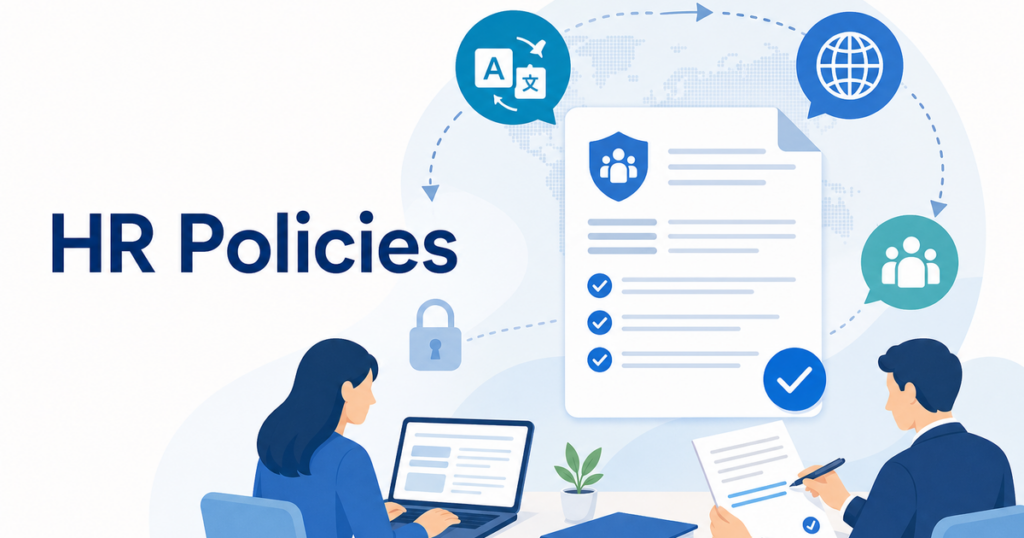
This article walks through a practical workflow for translating HR policies using AI-generated drafts followed by structured human review.
Why HR Policy Translation Needs Extra Care
HR documents sit in a category that is neither casual internal communication nor formal legal filing. They carry weight. A dress code policy, an anti-harassment procedure, or a leave-of-absence guideline all set expectations that employees rely on and that regulators may scrutinize.
The EEOC has published enforcement guidance on national origin discrimination that underscores the importance of making workplace policies accessible to employees who speak different languages. When policies are not available in a language employees understand, it can contribute to disparate treatment claims and create enforcement risks.
Source: https://www.eeoc.gov/laws/guidance/eeoc-enforcement-guidance-national-origin-discrimination
At the same time, HR policies are not court filings. They do not usually require a professional, credentialed translation. What they need is accuracy, consistency, and a tone that matches your company culture. That makes them strong candidates for an AI-draft-plus-human-review workflow.
The AI-First, Human-Review Workflow
The core idea is straightforward: let the machine handle the heavy lifting of converting text from one language to another, and let a knowledgeable person confirm that the result says what it should.
Step 1: Prepare the Source Document
Before you translate anything, make sure your source document is clean and final. AI translation works best when the input is clear, well-structured, and free of tracked changes or comment bubbles.
If your policy lives in a Word document or PDF, check that headings use proper heading styles, tables are formatted as actual tables rather than tab-separated text, and numbered lists use consistent formatting. These structural elements help translation tools preserve your document layout.
If you are working with a PowerPoint deck used for policy training, the same principle applies. Clean slide masters, consistent text boxes, and legible fonts all contribute to better output.
Step 2: Generate the AI Draft
Upload your document to an AI translation tool that handles your file format. Tools like Jitan Translate support PDF, DOCX, PPTX, and XLSX files, which means your policy handbook, slide deck, or benefits spreadsheet can all go through the same process.
The tool is designed to preserve the original formatting, but reviewers should still verify tables, headings, and page breaks after translation. This still saves hours compared to copying translated text back into a formatted template by hand.
During this step, if your organization has specific terminology, such as product names, internal program titles, or industry-specific terms, check whether your translation tool supports a glossary or custom term list. Even a small glossary of twenty or thirty key terms can improve consistency across multiple policies.
Step 3: Assign a Qualified Reviewer
The AI draft is a starting point, not the final product. You need someone who understands both the language and the subject matter to review it. The ideal reviewer is:
- Fluent in the target language
- Familiar with your company's HR policies and tone
- Aware of any local labor law requirements in the region where the translated policy will apply
This does not have to be a professional translator. A bilingual HR coordinator or a local office manager often has exactly the context you need. The goal is not linguistic perfection in an academic sense. It is making sure the policy communicates its intent clearly to the employees who will read it.
Step 4: Review for Accuracy and Tone
Give your reviewer a structured checklist rather than asking them to "check the translation." A good checklist includes:
- Factual accuracy: Do the translated dates, amounts, and procedures match the original?
- Tone alignment: Does the translated policy sound like your company? If the original is warm and supportive, the translation should not read as cold and bureaucratic.
- Policy-critical terms: Are terms like "at-will employment," "qualified medical leave," or "reasonable accommodation" translated in a way that employees will understand?
- Cultural appropriateness: Are there references to holidays, legal concepts, or workplace norms that need adjustment for the target culture?
Step 5: Finalize and Distribute
Once the reviewer signs off, the document is ready for distribution. Because the tool aims to preserve formatting, you may need less manual reformatting, but final layout review is still recommended. Save the final version, upload it to your HRIS or intranet, and circulate it the same way you would any other policy update.
Keep a record of who reviewed the translation and when. This is not about creating legal protection, but it does establish a clear chain of accountability if questions come up later about what was communicated and to whom.
Handling Different HR Document Types
Employee Handbooks
Employee handbooks are usually the longest HR document. They cover everything from company history and mission to detailed policies on attendance, benefits, and conduct. Because they are comprehensive, translating a full handbook is a significant project.
Start by translating individual chapters or sections rather than the entire handbook at once. This makes the review process more manageable and allows you to distribute translated sections as they are completed rather than waiting for the entire document to be finished.
If your handbook is in DOCX format, the translation tool should preserve your table of contents, index entries, and cross-references. Verify these elements after translation, especially internal page references that may shift when translated text is longer than the original.
Policy Training Slide Decks
Many companies deliver policy training through PowerPoint presentations. These decks combine concise text with visuals, and the layout is often carefully designed to support the speaker's narrative.
When translating training decks, the priority is keeping slides readable. Translated text that is significantly longer than the original can overflow text boxes or push content off the slide. Design your original slides with extra space to accommodate text expansion during translation.
Benefits Enrollment Materials
Benefits documents often include comparison tables, coverage descriptions, and enrollment instructions. These materials are time-sensitive because they tie to open enrollment periods. AI translation's speed advantage is particularly valuable here, allowing you to produce translated benefits materials within tight deadlines.
Pay special attention to translating coverage amounts, copay figures, and deductible numbers. A misplaced decimal point or a confused currency symbol in a benefits description can mislead employees about their coverage.
Common Pitfalls and How to Avoid Them
Treating the AI Output as Final
The most common mistake is skipping the review step. AI translation has improved dramatically, but it still makes errors that a human would catch immediately. A policy that says employees "may" do something when the original says they "must" is a significant difference that no one wants to discover during an audit.
Inconsistent Terminology Across Policies
If you translate your anti-harassment policy in January and your leave policy in March, the AI might translate the same term differently each time. Maintaining a shared glossary and using the same translation tool for all policies helps keep language consistent across your handbook.
Ignoring Local Legal Context
AI translates language, not law. A translated policy that is perfectly accurate in one country may reference legal concepts that do not apply or mean something different in another country. Your local reviewer should flag these situations, but the HR team managing the process needs to be aware that legal localization is a separate concern from linguistic translation.
The CDC's plain language guidelines offer useful principles for writing health-related communications clearly. While HR policies are not health communications, the same emphasis on short sentences, active voice, and defined technical terms applies. Writing your source policies in plain language before translation improves the quality of every language version.
Source: https://www.cdc.gov/health-literacy/php/develop-materials/plain-language.html
Losing Formatting in the Process
If your translation workflow involves exporting text to a spreadsheet, translating it there, and pasting it back, you will spend hours reformatting. This is where file-format-aware translation tools provide the most value. They keep your tables, headers, bullet points, and page layouts intact so your reviewers can focus on content rather than formatting.
When You Might Still Need Professional Translation
The AI-draft-plus-review workflow works well for most internal HR policies. There are situations where you may want to engage a professional translation service instead:
- Policies that are being submitted to a government regulator as part of a compliance filing
- Documents related to a legal proceeding or formal investigation
- Communications that will be included in an employee lawsuit or grievance
In these cases, the formality and traceability of professional translation matter more than speed. You can still use AI translation as an internal reference, but the version you submit externally should come from a credentialed translator.
Building a Repeatable Process
The biggest advantage of the AI-draft workflow is that it scales. Once you establish the process with one policy, you can apply it to your entire handbook, your onboarding materials, and your benefits documentation.
Start by translating one or two high-priority policies, such as your code of conduct and your safety policy. Use those to refine your glossary, train your reviewers, and identify any gaps in your workflow. Then roll the process out to the rest of your document library.
If you work with documents in formats like PDF, DOCX, or PPTX, tools that handle those formats natively will save you time on every round. For a closer look at how file format affects the translation process, see this guide to translating PDFs without losing formatting.
Security Considerations for HR Documents
HR policies often contain sensitive information about company procedures, compensation structures, and internal operations. When you choose a translation tool, consider how your documents are handled during the translation process.
Key questions to ask:
- Are uploaded files stored on the provider's servers, and if so, for how long?
- Does the provider use your documents to train its AI models?
- Is data encrypted in transit and at rest?
- Can you delete your files from the provider's system after translation is complete?
The FTC provides guidance on evaluating vendor security practices that is relevant for any business sharing documents with a third-party service. Even when using AI translation tools, understanding how your data is handled is part of responsible HR document management.
Source: https://www.ftc.gov/business-guidance/small-businesses/cybersecurity/vendor-security
Conclusion
Translating HR policies does not have to be a bottleneck. By using AI to generate drafts and focusing human effort on structured review, HR teams can produce accurate, well-formatted translated policies in a fraction of the time that traditional translation requires.
The key is treating AI output as a strong first draft, not a finished product. Pair it with reviewers who understand both the language and the policy content, maintain a shared glossary for consistency, and keep security considerations in mind when selecting your tools. With this approach, multilingual policy distribution becomes a manageable, repeatable process rather than a recurring crisis.