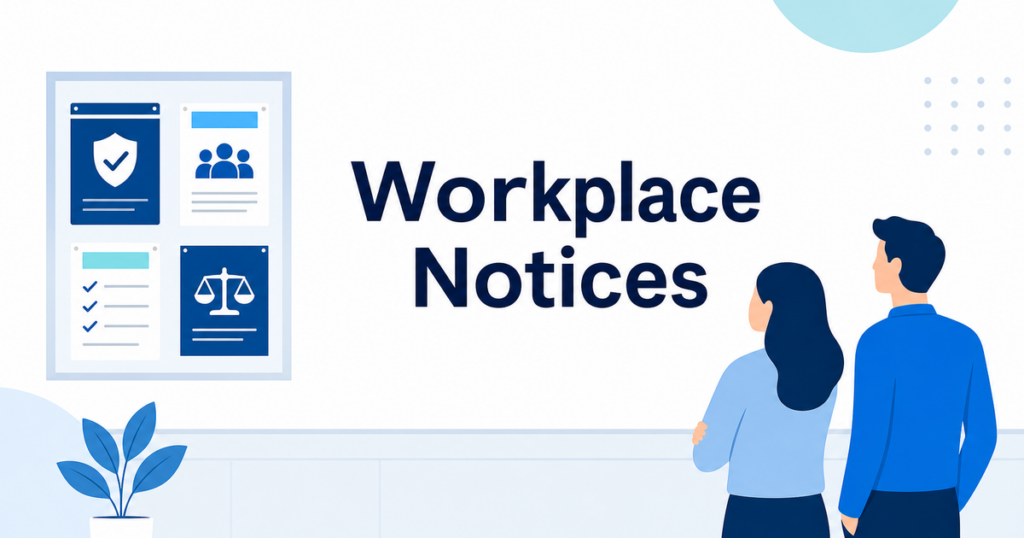

Walk into any break room in the United States and you will see a wall of posters and notices. Federal and state labor laws require employers to display certain notices where employees can see them. For businesses with multilingual workforces, the question quickly becomes: which of these need to be translated, and what is the best way to handle the rest?
This guide covers the practical side of workplace notice translation for small and mid-sized businesses. It explains what must be posted, what is available in translated versions from government agencies, and how to handle internal explanatory materials that go beyond the posted notices.
This article provides general information and is not legal advice. For specific compliance questions, consult the U.S. Department of Labor or qualified legal counsel.
The Federal Posting Landscape
The U.S. Department of Labor (DOL) requires employers to display certain workplace posters. These posters cover topics such as:
- Minimum wage requirements
- Occupational safety and health protections
- Family and Medical Leave Act (FMLA) rights
- Equal employment opportunity laws
- Employee polygraph protections
- Uniformed Services Employment and Reemployment Rights Act (USERRA)
Source: https://www.dol.gov/general/topics/posters/
The key thing to understand is that the DOL itself provides many of these posters in multiple languages. You do not need to translate them yourself. You need to know which ones are available and whether you are required to post a non-English version.
When Translation Is Required Versus Recommended
Federal Requirements
Federal posting requirements generally mandate that posters be displayed in a location accessible to all employees. The requirement to provide non-English versions depends on the workforce composition.
Some federal posters are available in Spanish and other languages directly from the DOL website. If a significant portion of your workforce speaks a language other than English, using the government-provided translated version is a practical step toward ensuring all employees can understand their rights.
State and Local Requirements
This is where it gets complicated. State and local posting requirements vary widely:
- Some states require specific posters to be displayed in languages other than English if a certain percentage of the workforce speaks that language.
- Some states provide translated posters on their labor department websites.
- Some states have their own poster requirements that go beyond federal mandates.
- Cities and counties may have additional requirements, particularly around paid sick leave, minimum wage, and anti-discrimination.
You need to check the labor department website for every state where you have employees. What is required in California may be completely different from what is required in Texas or New York.
The Practical Standard
Even when translation is not strictly required, the practical standard is clear: if your employees cannot understand a posted notice, the notice is not serving its purpose. From both a compliance perspective and a workforce management perspective, providing notices in languages your employees understand is the right approach.
A Framework for Handling Workplace Notices
Here is a practical framework for managing workplace notices in a multilingual environment.
Step 1: Audit Your Current Notices
Walk through your workplace and catalog every posted notice. For each one, note:
- What law or regulation it addresses
- Whether it is a federal, state, or local requirement
- What language it is currently in
- Where it is posted
- When it was last updated
This audit gives you a baseline. You may find outdated notices, missing notices, or notices that have been superseded by newer versions.
Step 2: Check for Official Translated Versions
Before translating anything yourself, check whether the relevant government agency provides a translated version:
- Federal posters: Check the DOL poster page.
- State posters: Check your state’s labor department website.
- OSHA posters: OSHA provides its “Job Safety and Health – It’s the Law” poster in multiple languages.
Using official translated versions is always preferable to creating your own, because official versions have been reviewed for legal accuracy.
Step 3: Identify Gaps
After checking for official translations, you will likely find:
- Some notices have no official translated version available.
- Some notices have translations in some languages but not the languages your workforce speaks.
- Some notices are available in translated versions but are outdated or from a different jurisdiction.
These gaps are where you need to decide how to provide supplementary information.
Step 4: Create Supplementary Explanatory Materials
For notices that do not have official translated versions, you can create internal explanatory documents that summarize the key points in your employees’ languages.
These supplementary materials should be:
- Clearly labeled as explanatory summaries, not official legal notices
- Posted alongside the official notice, not as a replacement
- Reviewed by a bilingual professional who understands the employment law concepts
- Updated whenever the official notice changes
A document translation tool can help you create initial drafts of these explanatory materials. Upload the English notice as a PDF or DOCX, generate a translated draft, and have a bilingual reviewer refine it.
Step 5: Establish a Maintenance Process
Workplace notices change. Minimum wage rates increase, new laws are enacted, and existing regulations are amended. Build a process to keep up:
- Subscribe to DOL email updates for posting requirement changes.
- Check your state labor department website quarterly for updates.
- Assign someone in HR or operations to review all posted notices at least twice a year.
- When an English notice is updated, immediately check whether a corresponding translated version is available and update any supplementary explanatory materials.
Beyond the Wall: Internal Notices and Communications
The posters on the break room wall are only part of the story. Many workplace communications need to reach multilingual employees:
Policy Changes and Updates
When you announce changes to policies, benefits, or procedures, consider how non-English-speaking employees will learn about them. A translated summary distributed alongside the English announcement ensures broader understanding.
Benefits Enrollment Materials
Open enrollment periods, benefit plan changes, and wellness program information are all high-stakes communications. Employees who do not fully understand their benefits options may make choices that do not serve them well.
Safety Alerts and Recalls
When a safety alert or equipment recall is issued, speed matters. Having a process to quickly translate urgent safety communications can prevent injuries.
Company-Wide Announcements
Organizational changes, new leadership introductions, and company event announcements may not be legally required to translate, but doing so builds inclusion and reduces the spread of rumors that can arise when some employees feel left out of the information loop.
The EEOC Perspective on Language in the Workplace
The Equal Employment Opportunity Commission (EEOC) provides enforcement guidance on national origin discrimination, which includes language-related issues.
Source: https://www.eeoc.gov/laws/guidance/eeoc-enforcement-guidance-national-origin-discrimination
Key takeaways for employers:
- English-only rules must be justified by business necessity and narrowly tailored. You cannot impose a blanket English-only rule at all times.
- Language preferences cannot be used as a proxy for national origin discrimination in hiring or employment decisions.
- Accent and fluency requirements must be job-related and consistent with business necessity.
These principles affect how you approach notice translation. Providing translated materials is generally viewed as a positive accommodation that supports equal access to workplace information.
Digital Notices and Email Communications
The physical wall of posters is only part of the notice landscape. Many workplace communications are now delivered digitally:
- Company intranet announcements about policy changes
- Email notifications about benefits enrollment deadlines
- Slack or Teams messages about safety alerts
- Digital pay stub notifications and tax form availability
These digital communications need the same translation attention as physical posters. In some ways, digital communications are easier to handle because you can maintain translated templates and send them automatically based on language preference. But they also require more vigilance because the volume and frequency of digital communications is much higher than physical postings.
When implementing multilingual digital communications:
- Add a language preference field to your employee profile system.
- Create translated templates for recurring communications (benefits enrollment, policy updates, safety alerts).
- Send communications in the employee’s preferred language automatically when a template is available.
- For ad-hoc communications, use a translation tool to create a draft and have a reviewer check it before sending.
A Practical Implementation Timeline
For a small business starting from scratch with multilingual workplace notices, here is a realistic timeline:
Week 1: Audit and research. Walk through your workplace and catalog every posted notice. Check federal, state, and local labor department websites for official translated versions. Identify which languages your workforce speaks and which notices have no official translation available.
Week 2: Create supplementary materials. For notices without official translated versions, draft plain-language explanatory summaries in English. These should be concise (one page or less per notice) and focus on the key points employees need to understand.
Week 3: Translate and review. Use a document translation tool to create drafts of your supplementary materials. Have bilingual reviewers check the translations for accuracy and clarity. For the most critical notices (safety, anti-discrimination, minimum wage), prioritize thorough review.
Week 4: Post and communicate. Install the official translated posters alongside the English versions. Distribute supplementary explanatory materials to supervisors and team leads. Hold a brief all-staff meeting or send a communication explaining that translated materials are now available and where to find them.
This four-week timeline gets you from zero to a functional multilingual notice system. Ongoing maintenance requires only periodic checks for regulatory updates and annual reviews of supplementary materials.
Common Mistakes to Avoid
Mistake 1: Relying on Bilingual Coworkers for All Translation
While bilingual employees are a valuable resource, relying on them exclusively for translating notices and communications has risks:
- They may not be familiar with the legal terminology.
- They may simplify or interpret rather than translate accurately.
- It adds to their workload without additional compensation.
- Translation quality varies with their proficiency in both languages.
Use bilingual employees as reviewers, not primary translators.
Mistake 2: Posting Translated Notices Without the English Version
Translated explanatory materials should supplement, not replace, the official English notices. The English version is the legally authoritative document. Post both side by side.
Mistake 3: Translating Once and Forgetting
A translated poster from 2023 may not reflect 2026 minimum wage rates or regulatory changes. Treat translated materials with the same update discipline you apply to English materials.
Mistake 4: Assuming One Language Covers All
If your workforce includes speakers of three different languages, a Spanish-only translation does not solve the problem for the other two. Assess the actual language needs of your workforce rather than making assumptions.
Summary
Handling workplace notice translation is a practical process, not a mystery. Start by auditing what you have, check for official translated versions from government agencies, create supplementary explanatory materials for the gaps, and build a maintenance process to keep everything current.
The goal is not perfection on day one. It is building a system that ensures every employee can understand the notices and communications that affect their rights, safety, and daily work life.
What to Discuss With Your Legal Counsel
If your business operates in multiple states or has a significant multilingual workforce, a brief conversation with your employment attorney can save time and reduce risk. Key topics to raise:
- Which of our posted notices have specific translation requirements in the states where we operate? Your attorney can identify state-specific mandates that may not be obvious from reading federal guidance alone.
- Are there pending regulatory changes that will affect posting requirements or language obligations in the coming year?
- What is our exposure if a translated explanatory summary contains an inaccuracy? Understanding the risk profile helps you decide how much review to invest in supplementary materials versus relying solely on official government translations.