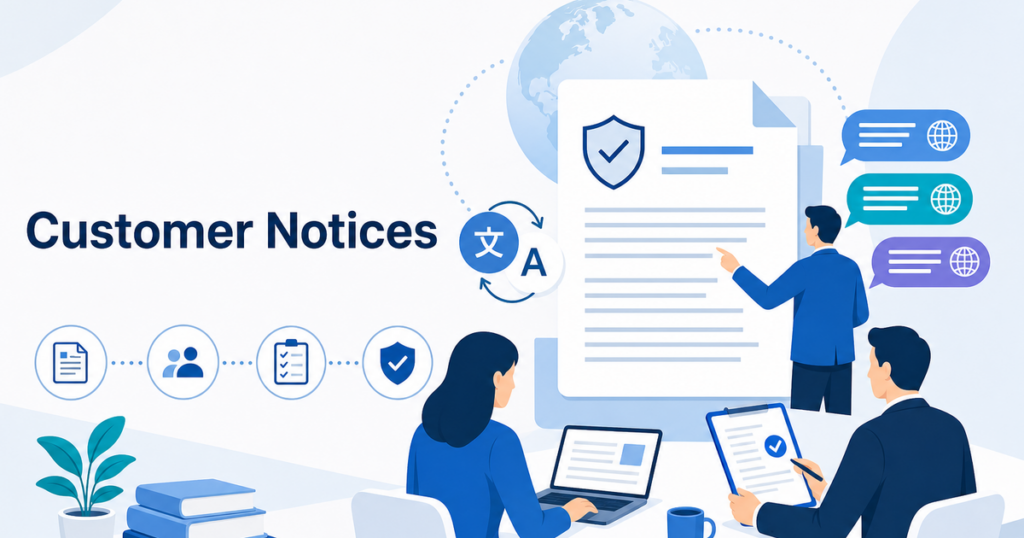

Warranty documents and customer notices occupy a space where product communication meets legal obligation. They tell customers what they can expect from your product, what you will do if something goes wrong, and what their rights are. When these documents need to reach customers in multiple languages, the translation must be both clear and carefully reviewed.
This article covers how to translate warranty documents and customer notices, with practical guidance on workflows, review, and the caution that legal-adjacent content demands.
Planning Ahead for Multilingual Warranty and Notices
Build Translation into Your Document Creation Process
The easiest way to handle warranty and notice translation is to plan for it from the start. When you write your original warranty terms:
- Use clear, straightforward sentence structures that translate well
- Avoid idioms, colloquialisms, and culturally specific references
- Define key terms explicitly so there is no ambiguity about what they mean
- Use consistent terminology throughout, so the same concept is always expressed the same way
These practices improve the original document and make every translation more reliable. When the source is clear, translations are more likely to capture the intended meaning.
Maintain a Template Library
Create templates for common notice types: warranty terms, recall notices, product change notifications, and discontinuation notices. Pre-translate the boilerplate portions of these templates into your target languages. When you need to issue a notice, you only need to translate the specific details, not the standard framework.
This approach is especially valuable for time-sensitive notices like recalls, where speed matters and the basic structure of the notice is predictable.
What Makes Warranty and Notice Translation Different
Warranty documents and customer notices share characteristics that distinguish them from general business translation:
- They create expectations: A warranty document tells the customer what is covered, for how long, and under what conditions. A translation that changes the scope of coverage, even unintentionally, can create disputes.
- They carry legal weight: Depending on the jurisdiction, warranty terms and customer notices may be subject to consumer protection laws. Translated versions need to accurately reflect the original terms.
- They are concise and specific: Warranty documents use precise language about coverage periods, exclusions, and claim procedures. Customer notices about recalls or product changes need to communicate clearly without ambiguity.
- They may be required by law: In many markets, consumer products must include warranty information in the local language. Customer notices related to safety or recalls may also have language requirements.
These characteristics mean that while AI translation can accelerate the process, the review step is especially important for these documents.
Types of Documents in This Category
Warranty Terms and Conditions
The core warranty document outlines what is covered, the duration of coverage, exclusions, and the process for making a claim. It typically includes:
- Coverage scope, such as parts, labor, or both
- Coverage period, often expressed in years or usage limits
- Exclusions, such as damage from misuse or unauthorized modifications
- Claim procedures, including where to send the product and what documentation to include
- Limitations of liability
Warranty Cards and Registration Forms
Many products include a warranty registration card or direct customers to an online registration page. These forms collect customer information and product details. They are relatively simple to translate but must accurately capture form fields and instructions.
Recall Notices and Safety Alerts
When a product is recalled or a safety issue is identified, customer notices need to go out quickly in all relevant languages. Speed matters, but accuracy matters even more. A recall notice that is translated incorrectly could cause customers to take the wrong action, or fail to act when they should.
Product Change Notifications
When a product formulation, specification, or feature set changes, customers may need to be notified. These notices need to clearly explain what changed, why it changed, and what action, if any, the customer needs to take.
End-of-Life and Discontinuation Notices
When a product is being discontinued, customers need to know how long support and parts will be available, what replacement products are offered, and whether existing warranties will be honored.
Translation Workflow for Warranty Documents
Step 1: Finalize the Source Document
Warranty documents should be fully approved by your legal and product teams before translation begins. Because these documents define contractual obligations, changes after translation create the risk that different language versions contain different terms.
Ensure that your source document uses clear, unambiguous language. The CDC's plain language guidelines emphasize using short sentences, active voice, and defined technical terms, principles that improve both the original warranty document and its translations.
Source: https://www.cdc.gov/health-literacy/php/develop-materials/plain-language.html
Step 2: Identify Non-Translatable Elements
Some elements in warranty documents should not be translated:
- Product model numbers and serial number formats
- Company legal entity names
- Specific law or regulation references
- Contact information such as phone numbers, email addresses, and mailing addresses
- Website URLs for warranty claim submissions
Mark these elements clearly so they pass through the translation process unchanged.
Step 3: Generate the AI Translation Draft
Upload your warranty document to a translation tool that preserves formatting. Warranty documents often include tables of coverage periods, numbered exclusion lists, and formatted claim procedures. Format-aware translation ensures these structures remain intact.
Tools like Jitan Translate handle DOCX and PDF files, which are the most common formats for warranty documents. The translation is designed to preserve your document layout, including table formatting and section numbering, with review recommended.
Step 4: Conduct a Careful Review
Warranty document review requires more rigor than general business document review. Your reviewer should:
- Compare the translated coverage scope, period, and exclusions against the original line by line
- Verify that all exclusions are present and accurately translated
- Check that claim procedures describe the correct process
- Confirm that limitation of liability language matches the original intent
- Ensure that legal terms are translated using the appropriate terminology for the target jurisdiction
This review should be conducted by someone who understands both the language and the product warranty terms. In many organizations, the legal or compliance team provides a secondary review of translated warranty documents.
Step 5: Handle Jurisdiction-Specific Adjustments
Warranty terms may need to be adjusted for different markets based on local consumer protection laws. For example, some jurisdictions impose minimum warranty periods or prohibit certain types of exclusions that are standard in other markets.
AI translation handles language conversion, but legal localization requires human judgment. Work with local counsel or compliance experts to identify any adjustments needed beyond straightforward translation.
Translation Workflow for Customer Notices
Time-Sensitive Notices
For recall notices and safety alerts, speed is critical. Prepare a translation workflow in advance so that when a notice needs to go out, you can execute quickly:
- Pre-approve translation templates for common notice types
- Maintain a glossary of standard notice terminology
- Identify reviewers who can respond quickly when urgent notices arise
- Test your workflow with practice notices before a real event occurs
Having these elements in place means you can produce translated notices in hours rather than days when the situation demands it.
Coordinating with Legal and Compliance Teams
Warranty and notice translation should not happen in a vacuum. Before finalizing any translated document, loop in your legal or compliance team for a final review. They can verify that the translated terms align with the company's actual obligations and that nothing in the translation inadvertently expands or limits the warranty coverage.
This review does not need to be time-consuming if you have pre-approved templates and a shared glossary. The goal is a quick confirmation that the translation matches the intent, not a line-by-line legal analysis.
Routine Notices
For product change notifications, discontinuation notices, and other routine communications, the standard translate-and-review workflow applies. The key consideration is ensuring that the notice clearly communicates the action the customer needs to take, if any, and that this call to action is unambiguous in the translation.
Common Pitfalls
Softening Exclusions
AI translation sometimes softens the tone of exclusion language. An original that says "This warranty does not cover damage caused by misuse" might be translated to a version that reads as less absolute. Review exclusion language carefully to ensure that the translated version maintains the same scope and firmness as the original.
Ambiguous Coverage Periods
Date and time formats vary by region. A coverage period expressed as "01/02/2026" means February 1 in most of the world but January 2 in the United States. Use explicit date formats, such as "February 1, 2026," or the ISO format "2026-02-01" to avoid confusion in translated documents.
Missing the Call to Action
Customer notices exist to prompt the reader to do something: return a product, visit a website, contact support. The translated notice must make this call to action equally clear. Review each translated notice to confirm that the action item is prominent and unambiguous.
Number and Unit Formatting
Warranty documents frequently include numbers: coverage periods in years or months, serial number formats, monetary limits, and measurement units. Different regions format these differently. Make sure your translated documents use number formats and unit conventions that are standard in the target market.
For example, a warranty period stated as "24 months" should not be ambiguously reformatted as "2 years" unless the original explicitly says two years. Serial number formats should be preserved exactly as they appear in the original, since they are used for product identification and lookup.
Inconsistent Terminology Across Documents
If your warranty document, product manual, and website use different translations for the same terms, customers receive mixed signals about what is covered and how to make a claim. Maintain a shared glossary across all customer-facing documents to keep terminology consistent.
When to Engage Professional Translation
AI-assisted translation with thorough human review works for most warranty documents and customer notices. Consider professional translation services when:
- The document will be filed with a government regulator
- The warranty is offered in a market with strict consumer protection enforcement
- The document is related to a product liability claim or legal proceeding
- Local law requires translated documents to be produced by a credentialed translator
In these situations, you can still use AI translation to create a working draft that speeds up the professional translator's work.
Version Control and Archiving
Warranty documents change over time. Coverage terms get updated, exclusions get revised, and claim procedures get modified. Keep a clear record of:
- Which warranty version applies to which product batch or model year
- Which translated version corresponds to which source version
- When each version was in effect
- Who reviewed each translated version
This documentation is valuable if a customer dispute arises about what warranty terms were in effect when they purchased the product.
Conclusion
Translating warranty documents and customer notices requires careful handling of coverage terms, exclusions, and legal-adjacent language. AI translation can accelerate the process significantly, but the review step deserves extra attention for these documents.
By finalizing source documents before translation, maintaining a shared glossary, conducting rigorous reviews, and keeping clear version records, you can produce translated warranty documents and customer notices that accurately communicate your commitments to customers in every market you serve.
The caution is straightforward: treat translated warranty documents with the same care you give the originals. Your customers depend on them, and your business is bound by them.