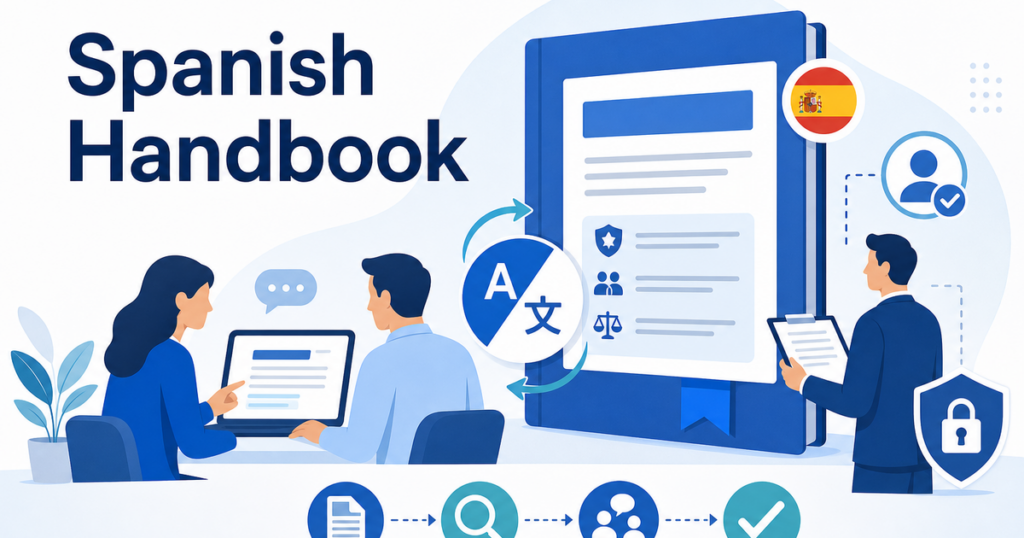

An employee handbook is one of the most important documents in any organization. It sets expectations, communicates policies, and serves as a reference that employees return to throughout their tenure. When your workforce includes Spanish-speaking employees who are more comfortable reading in their own language, translating the handbook into Spanish is not just a courtesy but a practical necessity.
But translating an employee handbook is not as simple as running the document through a translation tool and distributing the output. Handbooks contain legal language, company-specific policies, and nuanced instructions that need to be accurate and understandable. A poorly translated handbook can create more problems than no translation at all, because employees may rely on incorrect information.
This article walks through a practical, step-by-step workflow for translating an employee handbook into Spanish, from preparation through distribution and ongoing maintenance.
Why Translate Your Employee Handbook into Spanish
Legal and Compliance Considerations
In the United States, employers have a responsibility to ensure that employees understand workplace policies, safety procedures, and their rights. When a significant portion of the workforce speaks Spanish as their primary language, providing policies only in English may not meet this obligation.
OSHA requires that safety training be provided in a language that employees can understand. While this specifically addresses training, the same principle applies to written safety policies contained in the handbook.
Source: https://www.osha.gov/complianceassistance/training-resources
The EEOC's guidance on national origin discrimination notes that English-only policies must be justified by business necessity and that employers should consider the impact of language policies on non-native English speakers.
Source: https://www.eeoc.gov/laws/guidance/eeoc-enforcement-guidance-national-origin-discrimination
Practical Benefits
Beyond compliance, a Spanish-language handbook delivers concrete benefits:
- Fewer misunderstandings. Employees who read policies in their primary language are less likely to misinterpret rules around attendance, benefits, or conduct.
- Faster onboarding. New Spanish-speaking hires can get up to speed independently rather than relying on bilingual colleagues to explain every policy.
- Reduced legal risk. If a dispute arises about whether an employee was informed of a policy, having provided the handbook in the employee's language strengthens your position.
- Improved morale. Providing materials in an employee's preferred language signals respect and inclusion, which contributes to retention.
Step 1: Audit the Current Handbook
Before translating anything, review the existing English handbook critically.
Is It Up to Date?
Translate only the current version. If the English handbook has not been updated recently, revise it first. Translating outdated policies and then updating both versions doubles your work.
Is It Clearly Written?
Handbooks written in dense, legalistic English are harder to translate accurately and harder for Spanish-speaking employees to understand even after translation. Simplify the English version before translating.
Key principles for clear handbook writing:
- Use short sentences and common words
- Avoid jargon, acronyms, and ambiguous phrasing
- Organize policies into clearly labeled sections
- Use bullet points and numbered lists for procedures
- Include a table of contents
The CDC's plain language guidelines provide a useful framework for writing clear, accessible content.
Source: https://www.cdc.gov/health-literacy/php/develop-materials/plain-language.html
Identify Company-Specific Terms
Make a list of terms that are unique to your company or industry. This includes product names, internal program names, job titles specific to your organization, and any acronyms that employees are expected to know. These terms need special handling during translation.
Step 2: Choose Your Translation Approach
Option A: Full Human Translation
A professional translator with experience in HR and employment law translates the entire handbook. This is the most expensive option but provides the highest quality, especially for legally sensitive content.
Best for: Organizations with large Spanish-speaking workforces, companies in highly regulated industries, or any employer concerned about legal exposure from translation errors.
Option B: AI Translation with Human Review
An AI translation tool produces a first draft, and a professional translator or bilingual HR professional reviews and corrects the output. A hybrid workflow can reduce translation effort compared with full human translation, but the savings vary by document type and review requirements.
Best for: Organizations that need to balance cost and quality, companies that update their handbooks frequently, or employers with bilingual HR staff who can perform the review.
Option C: AI Translation with Internal Spot-Check
An AI tool translates the handbook, and a bilingual employee reviews key sections, particularly those related to safety, benefits, and disciplinary policies. Less rigorous than Option B but more cost-effective.
Best for: Smaller organizations with limited budgets, handbooks that primarily contain straightforward policies without complex legal language, or as an interim measure while budgeting for professional review.
Step 3: Prepare the Document for Translation
Create a Terminology Glossary
Before translation begins, compile a glossary that specifies how key terms should be handled:
- Terms to keep in English. Product names, company name, internal program names that employees use in English even when speaking Spanish.
- Terms with specific Spanish translations. Job titles, policy names, benefit programs.
- Regional preferences. Specify which variety of Spanish to target. For a US workforce, this is usually US Spanish, which draws primarily from Mexican Spanish but incorporates terms common across Latin American varieties.
Decide on Formatting
Employee handbooks often include tables, charts, callout boxes, and other formatting elements. Decide in advance:
- Will the translated handbook maintain the same layout as the English version?
- How will you handle text expansion? Spanish text can be longer than English in many business documents, so tight layouts may need manual adjustment after translation.
- Will you produce a bilingual handbook (both languages in one document) or separate English and Spanish editions?
Using a translation tool that preserves document formatting saves significant time compared to reformatting the translated text from scratch.
Step 4: Execute the Translation
Using AI Document Translation
Modern AI translation tools can handle formatted documents including Word files, PDFs, and PowerPoint presentations. The process is straightforward:
- Upload the English handbook document
- Select English to Spanish as the language pair
- Apply any custom terminology or glossary settings the tool supports
- Run the translation
- Download the translated document
The output will be a Spanish-language document that maintains the original formatting. However, it will need review.
Human Review Process
Whether the initial translation is done by AI or a human translator, the review process should include:
- Accuracy review. Compare the Spanish translation against the English original section by section. Look for omissions, mistranslations, and additions that change the meaning.
- Fluency review. Read the Spanish text independently of the English to ensure it sounds natural. Awkward phrasing may be technically accurate but confusing to read.
- Legal and policy review. Have someone with knowledge of employment law review the sections on benefits, leave policies, anti-harassment, disciplinary procedures, and termination. These sections carry the highest risk if mistranslated.
- Formatting check. Verify that the translated document maintains the correct formatting, that text fits within tables and boxes, and that page breaks occur in logical places.
Step 5: Handle Sensitive Sections Carefully
Certain handbook sections deserve extra attention during translation:
At-Will Employment Language
If your handbook includes at-will employment disclaimers, the Spanish translation must be legally precise. Have an employment attorney review the Spanish version to ensure it carries the same legal meaning as the English.
Safety Policies
OSHA-referenced safety procedures must be translated accurately. Incorrect safety instructions can lead to injuries and create significant liability. Have a safety professional review the Spanish version of all safety-related sections.
Benefits and Compensation
Misunderstandings about benefits, eligibility, and compensation can lead to employee dissatisfaction and legal disputes. Ensure that the Spanish version clearly communicates the same information as the English.
Anti-Discrimination and Harassment Policies
These policies must be clearly understandable to all employees. If the translation is ambiguous or omits key details, employees may not understand their rights or the reporting process.
Step 6: Distribute and Communicate
Distribution Methods
- Provide both printed and digital copies to Spanish-speaking employees
- Make the Spanish handbook available on the company intranet or employee portal
- Include a copy in new-hire onboarding packets
- Send an email or notification when the translated version is available
Accompanying Communication
Do not just distribute the handbook and assume employees will read it. Accompany the distribution with:
- A brief email or letter in Spanish explaining that the handbook is now available in Spanish
- A summary of key policies in a one-page Spanish-language handout
- An opportunity for employees to ask questions about the translated content
Acknowledgment
Have employees sign an acknowledgment form confirming they received the handbook in their preferred language. Keep these acknowledgment forms on file.
Step 7: Maintain and Update
Version Control
Keep both English and Spanish versions under version control. When the English handbook is updated, flag the changes and translate the updated sections rather than re-translating the entire document.
Annual Review
At least once a year, review both versions to ensure they are still aligned. Policy changes, new regulations, and updated benefits information may require updates to both versions.
Feedback Loop
Encourage Spanish-speaking employees to report any sections of the translated handbook that are unclear or confusing. This feedback helps you improve the translation over time and catch errors that reviewers may have missed.
Common Mistakes to Avoid
Translating Once and Forgetting
Employee handbooks are living documents. Policies change, laws change, and company practices evolve. A Spanish handbook that is two years out of date may contain incorrect information that employees rely on. Build a process for keeping both versions current.
Skipping the Review Step
AI translation has improved dramatically, but it is not infallible. Distributing AI-translated content without any human review risks embarrassing errors in employee-facing materials, particularly in sections with legal or safety implications.
Using Machine Translation for Legal Disclaimers
Legal disclaimers, at-will employment statements, and arbitration clauses should always be translated or reviewed by a professional with legal translation experience. These are the sections where a mistranslation has the most significant consequences.
Ignoring Regional Spanish Differences
If your workforce includes employees from different Spanish-speaking countries, be aware that vocabulary and phrasing preferences vary. Aim for neutral Spanish that is broadly understood, and avoid colloquialisms that are specific to one country or region.
Handling Different Document Formats
Employee handbooks come in various formats, and the translation approach may need to adapt accordingly.
Word Documents
If your handbook is maintained as a Word document, translation is relatively straightforward. Word files are fully editable, and most AI translation tools preserve formatting elements like headings, tables, bullet points, and styled text. After translation, you may need to adjust page breaks and verify that expanded Spanish text fits within the existing layout.
PDF Handbooks
Some organizations distribute handbooks as PDFs to prevent unauthorized editing. Translating the source Word file and then converting to PDF is generally easier than translating the PDF directly. If only the PDF is available, use a translation tool that can handle PDF formatting while producing editable output.
Online Handbooks
If your handbook lives on an intranet, employee portal, or HR information system, the translation process needs to account for the web content management workflow. Coordinate with your IT or web team to create a Spanish-language section or parallel version of the handbook within the same platform.
Printed Handbooks
For organizations that distribute printed handbooks, the translated version needs to go through the same print production process as the original, including layout adjustments for text expansion, cover design, and binding specifications. Factor this additional production time into your project timeline.
Training HR Staff on the Translation Process
Your HR team plays a central role in the handbook translation process. Invest time in training them on:
When to Request Translation Updates
Train HR staff to flag handbook updates that require corresponding translation updates. Every time a policy changes, a new benefit is added, or a legal requirement shifts, the translation should be triggered automatically.
How to Brief Reviewers
HR staff who coordinate the review process should know how to brief bilingual reviewers effectively. This includes providing context for policy changes, highlighting sections that are new or significantly revised, and specifying any terminology preferences.
How to Communicate Changes
When the Spanish handbook is updated, HR needs to communicate the changes clearly to Spanish-speaking employees. This may involve sending a summary of changes in Spanish, posting an update notice on the company intranet, or discussing changes during team meetings.
Scaling Beyond the Handbook
Once you have a solid handbook translation process in place, you can extend the same workflow to other HR documents:
- Benefits summaries and enrollment guides
- Safety training materials and signage
- Performance review forms and templates
- Disciplinary action documentation
- Job descriptions and posting templates
- Workers' compensation information
Each of these documents benefits from the same classification, translation, review, and distribution framework you built for the handbook. The terminology glossary you created during the handbook project provides a foundation that ensures consistency across all translated HR materials.
Building a Sustainable Process
Translating an employee handbook into Spanish is a project, but maintaining it is an ongoing process. By investing time upfront in a clear workflow, a terminology glossary, and a review process, you create a system that handles updates efficiently and ensures that your Spanish-speaking employees always have access to accurate, current policy information.
The combination of AI translation for speed and human review for quality gives most organizations the best balance of cost and accuracy. Start with your current handbook, apply the workflow described above, and build from there as your translation needs grow.