Machine translation has improved dramatically over the past several years. For many business documents, marketing materials, internal communications, and customer-facing content, AI translation produces a solid first draft that needs only light review before use.
But there is a category of documents where machine translation alone is not sufficient. These are documents that sit at the intersection of business operations and legal obligation: contracts, regulatory filings, compliance policies, employment agreements, and similar materials. I call them “legal-adjacent” documents because they are not necessarily prepared by lawyers, but they carry legal weight.
This article explains when machine translation should be treated as a draft only, what the specific risks are, and how to build a review process that catches the problems machines miss.
What Makes Legal-Adjacent Documents Different
Legal-adjacent documents share several characteristics that make them challenging for machine translation:
Precision Matters More Than Fluency
In a marketing brochure, a slightly awkward sentence is a minor issue. In a contract, a slightly different interpretation of a clause can change the obligations of the parties involved. Machine translation optimizes for fluency, which sometimes means choosing the most natural-sounding phrasing rather than the most precise one.
Context Is Legal, Not Just Linguistic
Machine translation models are trained on general text. They do not consistently understand the legal implications of specific word choices. For example, “shall” and “will” are often interchangeable in everyday English, but in legal drafting, they can carry different levels of obligation. A translation that treats them the same may alter the document’s legal effect.
One Document References Many Others
Legal-adjacent documents often reference statutes, regulations, case law, or other contracts. Machine translation may translate the name of a statute into the target language, making it harder to look up the actual law. Or it may leave a legal term in English, creating confusion for readers who do not know the English legal system.
Errors Are Not Always Obvious
A mistranslated marketing slogan is usually apparent to a native speaker. A mistranslated indemnification clause may look perfectly reasonable until a dispute arises and one party argues that the translated version created a different obligation than the English original.
Document Types Where Machine Translation Needs Extra Review
Contracts and Agreements
Any document that creates binding obligations between parties falls into this category. This includes:
- Sales contracts and purchase orders
- Service agreements and statements of work
- Non-disclosure agreements (NDAs)
- Vendor and supplier agreements
- Partnership and joint venture agreements
- Licensing agreements
The risk here is that a translation error changes the rights or obligations of one party. Even small changes in wording can affect liability, payment terms, termination rights, or intellectual property ownership.
Employment Documents
Documents that govern the employer-employee relationship carry legal significance:
- Employment agreements
- Non-compete and non-solicitation agreements
- Employee handbooks with policy acknowledgments
- Termination and separation agreements
- Stock option and equity agreements
In these documents, a mistranslation could affect an employee’s understanding of their rights, benefits, or restrictions. This can create liability for the employer if the employee later argues they were misinformed.
Regulatory and Compliance Documents
Documents required by regulatory bodies or created to demonstrate compliance:
- Safety compliance documentation
- Environmental reports and filings
- Financial disclosures
- Audit responses and remediation plans
- Data protection impact assessments
Regulators expect precise language. A translation that approximates the required content may not satisfy regulatory requirements.
Intellectual Property Documents
Patent applications, trademark filings, and copyright registrations involve specialized terminology where precision is essential. Machine translation of these documents should always be reviewed by someone with IP knowledge in both the source and target languages.
Insurance Documents
Policy documents, coverage summaries, and claims correspondence contain specific terms of art. “Occurrence,” “claim,” “loss,” and “damage” have precise meanings in insurance contexts that may not carry over cleanly through machine translation.
Common Machine Translation Errors in Legal Context
False Friends and Legal Terminology
Many legal terms look similar across languages but mean different things. Machine translation can produce a plausible-looking result that is actually incorrect:
- The English “liability” can mean legal responsibility or financial debt, and different languages may use different words for each meaning.
- “Consideration” in contract law means something of value exchanged, not thoughtfulness.
- “Execution” of a contract means signing it, not killing someone, but some languages use the same word for both.
Inconsistent Terminology
Machine translation may translate the same term differently in different parts of a document. In legal documents, consistent terminology is essential. If “the Company” is translated as “l’entreprise” in one paragraph and “la societe” in another, it can create ambiguity about whether both terms refer to the same entity.
Loss of Conditional Structure
Legal documents rely heavily on conditional language: “if,” “provided that,” “subject to,” “notwithstanding.” Machine translation can mangle these structures, especially when they are nested. A sentence like “Notwithstanding Section 3.2, the Licensee may, provided that written notice is given, extend the term” contains three layers of conditionality. If the translation flattens or reorders these layers, the resulting obligation may be different.
Misplaced Negation
Legal language uses negation in specific ways: “shall not,” “nothing in this Agreement shall,” “without limiting the foregoing.” Machine translation can misplace the negation, turning a prohibition into a permission or vice versa.
Number and Date Errors
Machine translation sometimes converts number formats (1,000 becoming 1.000 in European notation, or vice versa) or date formats, which can change contract values or deadlines. These errors are easy to miss because the translation otherwise reads correctly.
A Review Process for Legal-Adjacent Translations
Step 1: Machine Translation as a First Draft
Use machine translation to produce the initial draft. This is efficient and cost-effective. The goal is to get 80-90% of the way there quickly.
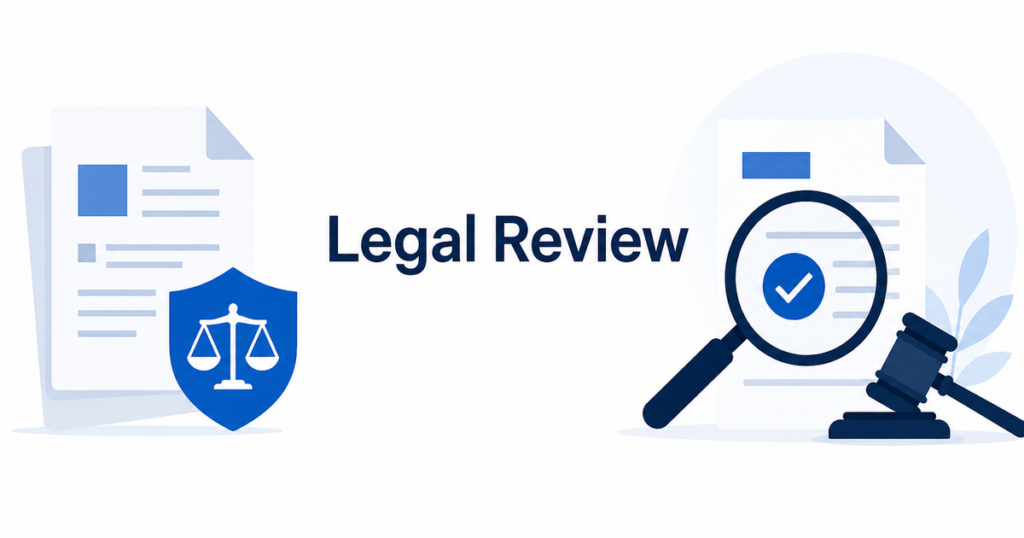
Step 2: Bilingual Legal Review
Have the machine translation reviewed by someone who:
- Is fluent in both the source and target languages
- Has experience with legal terminology in both languages
- Understands the subject matter of the document (employment law, IP, commercial contracts, etc.)
This reviewer should compare the translation against the source sentence by sentence, checking for:
- Accuracy of legal terms
- Consistency of terminology throughout the document
- Correct preservation of conditional structures and negation
- Proper handling of defined terms and cross-references
- Numbers, dates, and monetary amounts
Step 3: Legal Counsel Review
For high-stakes documents, have legal counsel review the translated version. This is especially important for:
- Documents that will be signed by both parties
- Documents that will be filed with a regulatory body
- Documents that affect employee rights or obligations
- Documents involving significant financial commitments
The American Bar Association has addressed the use of generative AI in legal practice, including considerations around translation and document preparation.
Step 4: Side-by-Side Comparison
For the most critical documents, produce a side-by-side comparison showing the English and translated versions. This allows anyone reviewing the document to quickly spot discrepancies.
Step 5: Certification When Required
Some situations require an officially accepted translation process, where a professional translator attests to the accuracy of the translation. Machine translation output cannot serve this purpose. If you need a translation that meets institution-required standards, engage a professional translation service.
Red Flags That Signal Machine Translation Is Not Enough
Watch for these indicators that a document needs more than standard machine translation:
- The document will be signed by the other party. If someone is agreeing to something in a language they read via machine translation, the risk of misunderstanding is high.
- The document creates or modifies legal rights. Employment agreements, NDAs, and IP assignments all fall into this category.
- The document will be filed with a government agency. Regulatory filings require precise language that matches the regulator’s expectations.
- The document involves significant financial exposure. Contracts with large dollar amounts, liability caps, or indemnification clauses.
- The document involves personal rights. Privacy notices, consent forms, and terms of service affect individuals’ rights and need to be clearly understood.
- You are unsure whether the translation is accurate. If you cannot verify the quality of the translation yourself, have a professional review it.
A Practical Framework for Deciding
Use this simple framework to decide how much review a translated document needs:
| Document Type | Machine Translation | Bilingual Review | Legal Review |
|---|---|---|---|
| Internal reference only | As-is acceptable | Helpful | Unnecessary |
| External informational | First draft | Recommended | Unnecessary |
| External, low stakes | First draft | Required | Optional |
| External, creates obligations | First draft | Required | Required |
| Regulatory filing | First draft | Required | Required |
| High-value contract | First draft | Required | Required |
What to Tell Your Team
If you are responsible for managing translation in your organization, communicate clear guidelines to your team:
- Machine translation is always a draft. No matter how good it looks, it has not been reviewed for legal accuracy. Treat it as a starting point, not a finished product.
- When in doubt, escalate. If a team member is unsure whether a document needs human review, the default answer should be yes. The cost of unnecessary review is far lower than the cost of an undetected error.
- Use the same tool consistently. Different translation tools may produce different translations of the same legal term. Consistency in tool choice reduces the risk of inconsistent terminology across documents.
- Keep a glossary. Maintain a shared glossary of key legal terms and their approved translations. This ensures that every document your organization produces uses consistent language, regardless of who handles the translation.
The Role of AI Risk Frameworks
As organizations increasingly use AI for tasks that intersect with legal and regulatory obligations, risk management frameworks provide useful guidance. The National Institute of Standards and Technology (NIST) has published an AI Risk Management Framework that addresses the responsible use of AI, including considerations around accuracy, reliability, and the need for human oversight in high-stakes applications.
Source: https://www.nist.gov/itl/ai-risk-management-framework
Applied to translation, the NIST framework reinforces the principle that AI-generated translations of legal-adjacent documents should be treated as drafts that require human validation before use in any context where accuracy has legal or financial consequences.
Summary
Machine translation is a powerful tool for legal-adjacent documents, but it is a starting point, not an endpoint. The characteristics that make these documents important, precision, legal effect, and binding obligations, are the same characteristics that make them vulnerable to translation errors.
Use machine translation to create an efficient first draft. Then invest in review proportional to the document’s stakes. For internal reference materials, light review may be sufficient. For contracts, regulatory filings, and employment documents, bilingual legal review is essential.
The cost of thorough review is always lower than the cost of a mistranslated obligation.
What to Discuss With Your Legal Team
If your organization regularly produces legal-adjacent documents in multiple languages, establish clear guidelines with your legal counsel:
- Which document categories require bilingual legal review versus standard bilingual review? Create a simple classification that your team can follow without needing to consult legal counsel each time.
- Should we maintain a list of approved legal translators? For documents that require professional human translation, having pre-vetted translators reduces the time spent finding qualified reviewers when a deadline is approaching.
- What is our internal standard for translation quality assurance on signed documents? Define the review process that must be completed before any translated document is presented for signature.