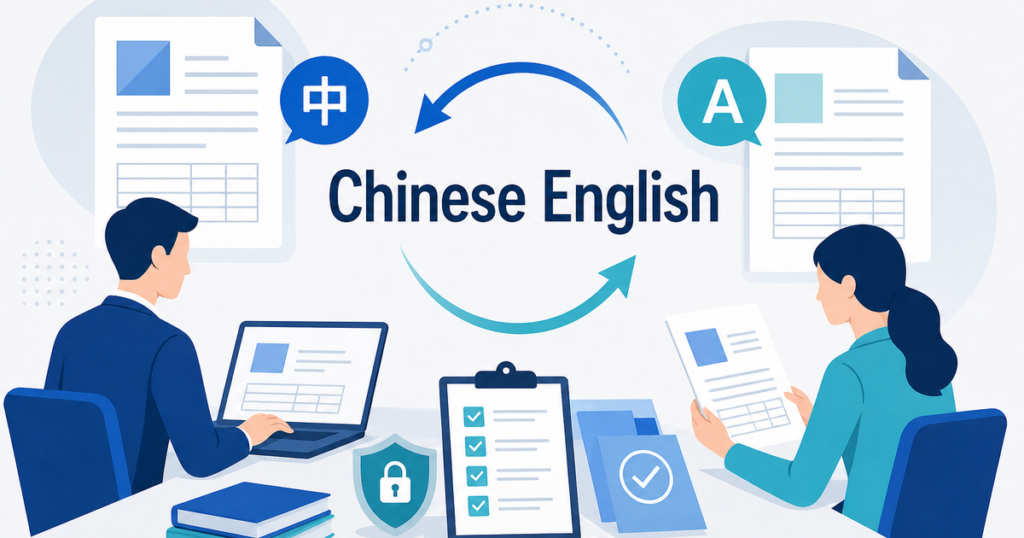
China's role in global supply chains, technology development, and manufacturing means that English-speaking business teams regularly encounter Chinese-language technical documents. From product specifications and engineering drawings to quality standards and regulatory filings, the volume of Chinese-English technical content that crosses organizational boundaries is substantial.
Translating technical documents between Chinese and English is a specialized discipline. The combination of complex technical terminology, precise numerical data, industry-specific conventions, and the structural differences between the two languages creates challenges that general-purpose translation tools may not fully address.
This article provides a practical guide for business teams that need to translate Chinese-English technical documents, covering common document types, key challenges, quality assurance strategies, and a recommended workflow.
The Scope of Chinese-English Technical Translation
Technical translation between Chinese and English covers a wide range of document types that business teams encounter regularly:
Manufacturing and Engineering
- Product specifications and bills of materials
- Engineering change notices and revision histories
- Manufacturing process instructions and standard operating procedures
- Quality inspection reports and defect analyses
- CAD drawing annotations and dimension callouts
Technology and Software
- API documentation and developer guides
- System architecture documents and technical design specifications
- User interface strings and localization files
- Test plans, test cases, and test result reports
- Data sheets and performance benchmarks
Regulatory and Compliance
- Regulatory filings and certification documents
- Safety data sheets and material safety information
- Environmental compliance reports
- Import and export documentation
- Standards compliance certificates
Supply Chain and Procurement
- Request for quotation and proposal documents
- Supplier qualification documents
- Purchase order terms and conditions
- Delivery specifications and logistics documentation
- Vendor audit reports and corrective action requests
Key Challenges in Chinese-English Technical Translation
Technical Terminology
Chinese technical writing uses a mix of native Chinese terms, transliterated English terms, and standardized translations that may not follow predictable patterns. For example:
- Some technical terms have well-established Chinese translations that differ from a literal translation of the English term
- Some industries use English terms directly, written in Chinese documents as-is
- New technologies may have Chinese terms that have not yet stabilized across the industry, with different sources using different translations for the same concept
A terminology glossary that captures the approved translations for your specific products and processes is essential for consistency.
Numerical Data and Units
Technical documents contain large volumes of numerical data: dimensions, tolerances, performance specifications, material properties, and test results. Errors in translating numbers, units, or decimal notation can have serious consequences in manufacturing and engineering contexts.
Chinese technical documents may use metric units, while US teams may need imperial equivalents, or vice versa. Unit conversion adds another layer of complexity and risk to the translation process.
Abbreviations and Acronyms
Both Chinese and English technical writing rely heavily on abbreviations and acronyms. Chinese technical documents may use:
- Pinyin abbreviations (romanized Chinese initials)
- English acronyms used as-is in Chinese text
- Industry-specific abbreviations that are not widely known outside the field
The translation must handle these correctly, either explaining them, converting them to English equivalents, or preserving them with appropriate context.
Diagrams and Visual Content
Technical documents frequently include diagrams, flowcharts, circuit schematics, and annotated illustrations. Text embedded in these visual elements needs to be translated, but the text is often in image format rather than editable text, making it harder to extract and translate.
Additionally, the spatial constraints of labels and callouts in diagrams mean that the translated text must fit within the same space as the original Chinese text. English text is often shorter than Chinese for the same concept, but not always, and layout adjustments may be necessary.
Context-Dependent Meaning
Chinese technical writing sometimes omits information that is implied by context. For example, a specification may reference "the standard" without specifying which standard, assuming the reader knows from context. A translator must either identify the specific standard being referenced or flag the ambiguity for clarification.
Building an Effective Translation Workflow
Step 1: Establish a Terminology Database
Before starting any translation work, create a terminology database that covers:
- Product-specific terms and their approved translations
- Industry-standard terminology from relevant standards organizations
- Common abbreviations and their expanded forms in both languages
- Terms that should remain untranslated (such as product names or proprietary designations)
This database should be a living document that is updated regularly as new terms are encountered and existing translations are refined.
Step 2: Choose the Right Translation Approach by Document Type
Different document types warrant different levels of translation investment:
Critical documents such as safety data sheets, regulatory filings, and contract specifications require professional human translation by a translator with subject matter expertise. Errors in these documents can have legal, safety, or financial consequences.
Standard technical documents such as product specifications, test reports, and process instructions can use AI-assisted translation with technical review by a subject matter expert. The AI produces a first draft, and the expert corrects technical terminology, verifies numerical data, and ensures accuracy.
Reference and informational documents such as internal reports, meeting summaries, and preliminary analyses can use AI translation with spot-check review for key terms and data points.
Step 3: Use Format-Preserving Translation Tools
Technical documents often have complex formatting: tables with precise column alignment, multi-level numbered lists, embedded equations, and mixed text-and-graphic layouts. Choose translation tools that preserve this formatting rather than requiring you to rebuild the document layout after translation.
Tools that handle formatted file types such as DOCX, PPTX, XLSX, and PDF directly save significant time and reduce the risk of formatting errors that can obscure the translated content.
Step 4: Implement a Quality Assurance Process
Quality assurance for technical translation should include multiple checks:
Terminology verification. Check that all terms in the terminology database have been translated consistently throughout the document.
Numerical accuracy. Compare all numbers, units, tolerances, and specifications between the source and target documents. A single misplaced decimal point can change a dimension from millimeters to meters.
Completeness check. Verify that no sections, paragraphs, or annotations have been omitted. Technical documents often contain information that every piece of which matters.
Technical review. A subject matter expert reviews the translated document for technical accuracy. This person should understand the engineering or scientific concepts described and be able to spot translations that are technically incorrect even if they are grammatically valid.
Formatting review. Verify that tables, diagrams, and other visual elements are correctly rendered in the translated document and that text fits within the intended boundaries.
Step 5: Handle Revisions and Updates
Technical documents are revised frequently. Engineering change notices, updated specifications, and revised procedures all generate new versions that need translation.
Maintain a clear link between source and translated versions so that when a source document is updated, you can identify which sections changed and translate only the updated content rather than re-translating the entire document.
Common Pitfalls and How to Avoid Them
Treating All Technical Translation as Equal
A product specification for a consumer electronic device has different translation requirements than a safety data sheet for an industrial chemical. Matching the translation approach to the document's risk level and audience saves money on low-risk content while protecting quality on high-risk content.
Skipping the Terminology Glossary
Without a glossary, the same term may be translated differently across documents, creating confusion for engineers and quality teams who reference multiple documents. The upfront investment in building a glossary pays off quickly in consistency.
Ignoring Embedded Text in Diagrams
Technical documents often contain critical information in diagrams, charts, and illustrations. If the translation process only handles the main body text and skips embedded visual content, the translated document is incomplete.
Neglecting Unit Conversion
When translating between Chinese documents that use SI units and US documents that may use imperial units, unit conversion must be handled explicitly. Do not assume the reader will convert units mentally. Either convert the values in the translation or clearly note the units being used.
Over-Relying on AI Without Technical Review
AI translation has improved significantly for Chinese-English, but it still makes errors in technical contexts. Unusual terminology, context-dependent abbreviations, and industry-specific conventions can trip up even the best AI systems. A subject matter expert review catches these errors before they reach the engineering team.
Tools and Resources
Translation Memory
Translation memory systems store previously translated segments and suggest them when similar or identical text appears in a new document. For teams that translate large volumes of technical content, translation memory improves consistency and speeds up the translation of repetitive content such as standard clauses, common warnings, and repeated specifications.
AI Document Translation
AI-powered document translation tools can help preserve the structure of formatted files, but reviewers should verify the final layout before sharing technical documentation. For technical documents, the key is choosing a tool that performs well on Chinese-English technical content and supports the file formats your team uses.
Subject Matter Expertise
The most valuable resource in technical translation is a subject matter expert who understands both the technical domain and the nuances of both languages. Whether this person is an internal team member or an external consultant, their review is what transforms a translated document from possibly correct to reliably accurate.
Managing Translation at Scale
For teams that translate Chinese-English technical documents regularly, volume management becomes a practical concern. Here are strategies for handling large translation workloads efficiently.
Batch Processing
Group similar documents for translation together. Product specifications for the same product line, test reports for the same project, or process instructions for the same manufacturing step share vocabulary and context. Translating them in batches allows the translator or AI tool to maintain consistency and context across related documents.
Translation Memory Leverage
If you use translation memory tools, leverage them fully by maintaining a clean, well-organized memory database. Regularly audit the translation memory to remove outdated entries and ensure that the stored translations reflect your current terminology preferences.
Prioritization Framework
Not all technical documents need the same turnaround time. Establish a prioritization framework:
- Urgent: Documents blocking production or shipment (same-day translation)
- High priority: Documents needed within the current project phase (one to three business days)
- Standard: Documents for reference or future use (three to five business days)
- Low priority: Archive or informational documents (one to two weeks)
This framework prevents bottlenecks by focusing resources on the documents that matter most at any given time.
The Role of NIST AI Risk Management Framework
For organizations using AI translation tools in technical contexts, the National Institute of Standards and Technology (NIST) AI Risk Management Framework provides a useful reference for evaluating and managing AI-related risks.
Source: https://www.nist.gov/itl/ai-risk-management-framework
The framework emphasizes trustworthiness characteristics including accuracy, reliability, and safety, all of which apply to AI translation of technical documents. Applying this framework to your translation tool evaluation helps you assess whether a particular tool meets your quality and risk management requirements.
Practical Tips for Business Teams
- Start with your most critical document type. If you regularly translate product specifications, focus your initial workflow development on that document type before expanding to others.
- Invest in the glossary early. The terminology database is the foundation of consistent translation. Build it incrementally with each translation project, and it will quickly become one of your most valuable assets.
- Standardize your source documents. Clear, well-structured English or Chinese source documents translate better than disorganized ones. Use consistent terminology, clear numbering, and standard formatting in your source files.
- Budget for human review. Even when using AI translation, budget time and money for subject matter expert review. The cost of catching errors during review is substantially lower than the cost of distributing inaccurate technical documentation.
- Track and improve. Maintain records of translation quality issues and use them to refine your workflow, update your glossary, and improve your source document practices over time.
Chinese-English technical document translation is a specialized but manageable process when approached systematically. By understanding the unique challenges, building the right workflow, and investing in quality assurance, business teams can handle the volume of cross-language technical content that US-China business relationships demand.