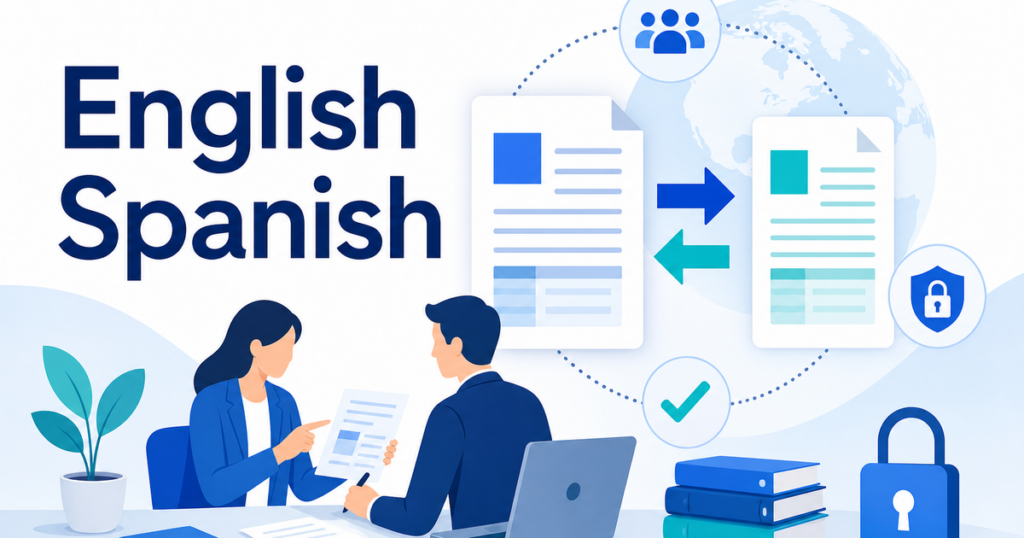
With over 41 million Spanish speakers in the United States, English-Spanish translation is the most common language pair American businesses encounter. From employee handbooks and safety notices to customer-facing marketing materials and legal documents, the demand for accurate English-to-Spanish and Spanish-to-English translation touches virtually every department in an organization.
Source: https://www.census.gov/newsroom/press-releases/2023/language-at-home-acs-5-year.html
This article covers the practical landscape of English-Spanish document translation for US businesses: what types of documents need translation, how to approach the workflow, what to watch for in quality, and how to build a repeatable process that scales.
Why English-Spanish Translation Matters for US Businesses
The Demographic Reality
According to the U.S. Census Bureau, Spanish is by far the most commonly spoken non-English language in the United States. The number of Spanish speakers has grown steadily over the past several decades, and this growth shows no sign of reversing.
Source: https://www.census.gov/newsroom/press-releases/2023/language-at-home-acs-5-year.html
For businesses, this means that Spanish-speaking employees, customers, and partners are not a niche audience. They are a core constituency that requires language access across many touchpoints.
Regulatory and Legal Drivers
Several federal and state regulations require or strongly encourage providing materials in languages other than English when a significant portion of the affected population has limited English proficiency.
The U.S. Department of Health and Human Services identifies limited English proficiency (LEP) as a critical access issue and provides guidance on language assistance programs.
Source: https://www.hhs.gov/civil-rights/for-individuals/special-topics/limited-english-proficiency/index.html
The Equal Employment Opportunity Commission (EEOC) addresses national origin discrimination, which includes language-based discrimination in certain employment contexts.
Source: https://www.eeoc.gov/laws/guidance/eeoc-enforcement-guidance-national-origin-discrimination
While these regulations do not always mandate translation of every document, they create a strong incentive for businesses to provide key materials in Spanish, especially in industries with large Spanish-speaking workforces.
Business Drivers
Beyond compliance, English-Spanish translation drives tangible business outcomes:
- Employee retention. Workers who understand company policies, safety procedures, and benefits information are more engaged and less likely to leave.
- Customer satisfaction. Spanish-speaking customers who can read product information, contracts, and support materials in their own language are more likely to trust your brand.
- Market expansion. Companies targeting Hispanic markets need marketing materials, product documentation, and website content translated to compete effectively.
- Risk reduction. Accurate translation of safety instructions, compliance documents, and legal notices reduces the risk of misunderstandings that lead to accidents, disputes, or litigation.
Types of Documents US Businesses Commonly Translate
Employee-Facing Documents
- Employee handbooks and policy manuals
- Safety training materials and workplace safety signage
- Benefits enrollment forms and summaries
- Performance review templates
- Disciplinary action forms and templates
- Onboarding checklists and orientation materials
OSHA requires that safety training be provided in a language that employees understand, which for many US workplaces means providing materials in Spanish.
Source: https://www.osha.gov/complianceassistance/training-resources
Customer-Facing Documents
- Product manuals and user guides
- Warranty terms and conditions
- Service agreements and contracts
- Marketing brochures and promotional materials
- Website content and FAQ pages
- Customer support scripts and knowledge base articles
Legal and Compliance Documents
- Terms of service and privacy policies
- Regulatory filings and disclosures
- Consent forms and waivers
- Data breach notification letters
- Insurance policy documents
Building an English-Spanish Translation Workflow
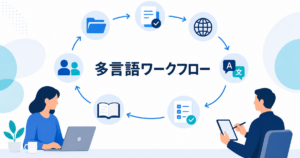
A reliable translation workflow involves more than running documents through a translation tool. Here is a practical process that balances speed, cost, and quality.
Step 1: Classify Your Documents by Risk Level
Not every document needs the same level of translation rigor. Classify your documents into tiers:
- Tier 1: High risk. Legal contracts, safety instructions, regulatory filings, medical information. These require professional human translation and review.
- Tier 2: Moderate risk. Employee handbooks, product manuals, marketing materials. These can use AI-assisted translation with human review.
- Tier 3: Low risk. Internal memos, informal communications, draft documents. AI translation with spot-check review is usually sufficient.
This classification helps you allocate budget where it matters most and avoid overspending on low-risk content.
Step 2: Choose Your Translation Tools
For English-Spanish, you have several options:
AI document translation tools can translate formatted documents such as PDFs, Word files, PowerPoint decks, and Excel spreadsheets while preserving the original layout. This is useful for documents that need to maintain their visual structure, such as training manuals and marketing materials.
Professional translation services provide human translators who specialize in English-Spanish. These services are more expensive but deliver higher quality, especially for nuanced or technical content.
Hybrid approach. Use AI translation to produce a first draft, then have a human translator review and correct the output. This often provides the best balance of speed, cost, and quality.
Step 3: Maintain a Terminology Glossary
English-Spanish translation is deceptively complex because Spanish varies significantly across regions. A term that is standard in Mexico may be unfamiliar in Puerto Rico, and vice versa. For US businesses, the most relevant varieties are typically Mexican Spanish, Puerto Rican Spanish, and Central American Spanish, depending on where your employees and customers are from.
Create and maintain a glossary of key terms with their approved Spanish translations. Include:
- Product names and technical terms that should not be translated
- Industry-specific jargon with agreed-upon Spanish equivalents
- Company-specific terms and acronyms
- Regional preferences for common terms
Share this glossary with both AI tools (if they support custom terminology) and human translators to ensure consistency across all translated documents.
Step 4: Build Review into the Process
Regardless of whether you use AI, human translators, or a combination, always include a review step. For AI translation, this means having a bilingual team member or professional reviewer check the output for accuracy, naturalness, and appropriate register.
For human translation, a second translator should review the work as a quality assurance step. This is standard practice in the translation industry and catches errors that the original translator may have missed.
Step 5: Track and Iterate
Keep records of translated documents, the tools and processes used, and any quality issues that arose. Over time, this data helps you identify which types of content translate well with AI, which require human intervention, and where your workflow can be streamlined.
Common Challenges in English-Spanish Translation
Regional Variation
As mentioned above, Spanish is not monolithic. A US business serving primarily Mexican-American communities needs different Spanish than one serving predominantly Puerto Rican or Dominican populations. Be intentional about which variety of Spanish you target and document this decision in your style guide.
False Cognates
English and Spanish share many words with similar roots, but some of these are false friends. For example, "embarazada" means pregnant in Spanish, not embarrassed. "Exito" means success, not exit. Professional translators and good AI tools handle these correctly, but they are a common source of errors in less careful translation.
Register and Formality
Spanish has formal and informal registers (usted vs. tu) that do not have direct equivalents in English. Choosing the wrong register can come across as overly familiar or inappropriately distant. Employee-facing documents typically use formal register, while marketing materials may use informal register depending on the brand voice.
Formatting and Layout
Translating from English to Spanish typically results in longer text. Spanish text can be longer than English in many business documents, so tight layouts may need manual adjustment after translation. Choose translation tools that handle layout adjustment or plan for manual formatting adjustments after translation.
When to Use AI vs Human Translation
AI Translation Works Well For
- Large volumes of internal documents where speed matters more than polish
- Drafts that will be reviewed and refined by a human translator
- Documents with consistent, predictable vocabulary
- Recurring document types such as standard forms and templates
Human Translation Is Necessary For
- Legal documents and contracts where precision is paramount
- Marketing and branding materials where tone and cultural resonance matter
- Documents with complex or ambiguous language
- Any content where translation errors could cause harm, such as medical information or safety instructions
The Hybrid Sweet Spot
For many US businesses, the most effective approach is to use AI translation to produce a first draft for Tier 2 and Tier 3 documents, then apply human review proportionate to the risk level. A hybrid workflow can reduce translation effort compared with full human translation, but the savings vary by document type and review requirements.
Measuring Translation Quality
How do you know if your English-Spanish translations are good enough? Consider these dimensions:
- Accuracy. Does the translation convey the same meaning as the original? Are there omissions or additions?
- Fluency. Does the Spanish read naturally, or does it sound like translated English?
- Terminology consistency. Are key terms translated the same way across all documents?
- Register appropriateness. Is the level of formality correct for the audience and context?
- Formatting integrity. Does the translated document maintain the layout and structure of the original?
Regular quality audits against these criteria help you maintain standards and identify areas where your workflow needs improvement.
File Format Considerations
The format of your source documents affects the translation process significantly.
Word Documents (DOCX)
Word files are among the easiest to translate because the text is fully editable and the formatting is relatively simple. Most translation tools handle DOCX files well, preserving styles, headers, tables, and images.
PDF Documents
PDFs are more challenging because the format was designed for display rather than editing. Translating a PDF requires either extracting the text and re-creating the document or using a specialized tool that can overlay translated text on the original layout. AI-powered tools that handle PDF translation directly have improved significantly and are worth considering if you work with PDF source materials frequently.
PowerPoint Presentations (PPTX)
PowerPoint files are common in sales, training, and corporate communications. The challenge with presentation translation is maintaining slide layouts, embedded fonts, and visual elements while replacing the text with Spanish equivalents. Tools that preserve PowerPoint formatting during translation save considerable time compared to manual reformatting.
Excel Spreadsheets (XLSX)
Excel files used for business documents such as pricing sheets, product catalogs, and inventory lists need translation of text cells while preserving formulas, number formatting, and calculations. Choose a translation tool that can distinguish between text content and numerical or formula content to avoid breaking your spreadsheets.
Building a Bilingual Team Culture
Effective English-Spanish translation is not just about tools and processes. It also depends on building a culture that values language access.
Empower Bilingual Employees
Bilingual team members are your most valuable translation resource. They understand your company's terminology, culture, and audience. Invest in their development by providing access to professional translation tools and giving them time to review translated materials as part of their regular responsibilities.
Normalize Translation in Workflows
Make translation a standard part of document creation rather than an afterthought. When a new policy is written, the translation request should be automatic, not something someone has to remember to initiate.
Measure and Communicate Impact
Track how translated materials are used and gather feedback from Spanish-speaking employees and customers. Share this data with leadership to demonstrate the return on investment and secure ongoing budget for translation efforts.
Practical Tips for US Businesses
- Start with your highest-impact documents. Translate the materials that affect the most people first, such as employee handbooks, safety signage, and key customer-facing documents.
- Invest in a style guide. Document your preferences for Spanish variety, formality level, terminology, and formatting. A shared guide improves consistency across every document you translate.
- Use format-aware translation tools. Reformatting a translated document from scratch wastes time. Tools designed to keep the translated output close to the original layout can reduce manual cleanup.
- Train your team. Ensure that employees who create documents that will be translated understand basic principles of writing for translation: use clear, simple language; avoid idioms and slang; be consistent with terminology; and provide context for ambiguous terms.
- Plan for updates. Documents change over time. Build a process for updating translations when the original English documents are revised, rather than treating each translation as a one-time project.
The Path Forward
English-Spanish document translation is not a one-time task but an ongoing operational need for most US businesses. By classifying documents by risk, choosing the right tools for each tier, maintaining a terminology glossary, and building review into your workflow, you can provide accurate, consistent Spanish-language materials to your employees and customers without breaking your budget.
The tools available today, from AI-powered document translation to professional human services, give you the flexibility to match your approach to each document's importance and risk profile. The key is having a system rather than translating ad hoc every time a new document comes across your desk.