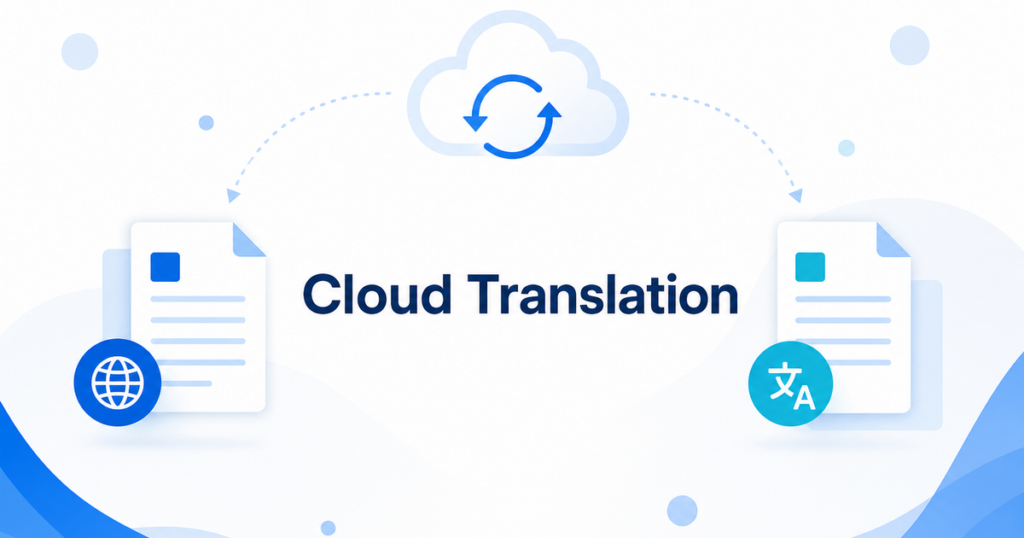

Google offers two paths for translating documents: the free Google Translate website and the paid Google Cloud Translation API. They both use Google’s machine translation technology, but they serve very different use cases.
The free web interface is designed for quick, one-off translations. The API is designed for teams that translate documents at scale, need automation, or require terminology control. Understanding the gap between them helps you decide which one fits your workflow and when neither is enough.
Google Translate (Web Interface)
Most people know Google Translate through its website or mobile app. You type or paste text, pick languages, and get a translation. The document upload feature extends this to files.
What it offers
- Free translation with no account required
- Document upload for .docx, .xlsx, .pptx, .pdf, and .txt files
- Automatic language detection or manual language selection
- Instant download of the translated file
Source: https://support.google.com/translate/answer/2534559
What it does not offer
- No glossary or custom terminology support
- No batch processing (one file at a time)
- No API access for automation
- No translation memory (previously translated segments are not reused)
- No access controls or audit logging
- Limited format preservation, especially for complex layouts
Best for
- Occasional, informal translations
- Getting the gist of a foreign-language document
- Translating a single file quickly when quality does not need to be high
Google Cloud Translation API
The Google Cloud Translation API is a developer-oriented service that provides programmatic access to Google’s translation models. It includes two main tiers: Basic (previously v2) and Advanced (previously v3).
Document Translation API
The Advanced tier includes a document translation feature specifically built for file-based translation. According to Google Cloud’s documentation, it supports a wider range of formats and provides more control over the translation process.
Source: https://docs.cloud.google.com/translate/docs/advanced/translate-documents
What the API offers that the web interface does not
Glossary support
You can upload a glossary that maps specific source-language terms to their approved translations. When the API encounters those terms, it uses your glossary definition instead of its default translation.
This is critical for business documents where product names, technical terms, and legal language need consistent handling across every file. A glossary ensures that “Revenue Recognition” always translates the same way, whether it appears in a contract, a training manual, or a slide deck.
Source: https://cloud.google.com/translate/docs/advanced/glossary
Batch processing
The API can translate multiple documents in a single request. You point it at a Cloud Storage bucket containing your source files, specify the target language, and it processes them all. For teams that translate dozens or hundreds of documents per week, this eliminates the manual upload-download cycle.
Broader format support
The API supports additional formats beyond what the web interface handles. According to Google Cloud’s documentation on supported formats, this includes some formats that the free tool does not accept.
Source: https://cloud.google.com/translate/docs/supported-formats
Automation and integration
Because it is an API, you can integrate document translation into your existing tools and workflows. Examples:
- A script that watches a shared folder and translates any new documents automatically
- A content management system plugin that translates articles before publication
- A pipeline that translates product documentation as part of the build process
Access controls and logging
Google Cloud projects have built-in IAM (Identity and Access Management) controls. You can restrict who can call the translation API, what languages they can use, and what buckets they can read from and write to. Cloud Logging captures every API call, creating an audit trail.
What the API requires
- A Google Cloud account with billing enabled
- A project configured with the Translation API enabled
- Developer resources to build and maintain the integration
- Understanding of Cloud Storage, IAM, and API authentication
Best for
- Teams translating at volume on a regular basis
- Organizations that need terminology consistency through glossaries
- Workflows that require automation and integration with other tools
- Projects with compliance or audit requirements
Side-by-Side Comparison
| Feature | Google Translate (Web) | Cloud Translation API |
|---|---|---|
| Cost | Free | Pay per character translated |
| Account required | No | Yes (Google Cloud) |
| Document upload | Yes, one file at a time | Yes, batch supported |
| Glossary support | No | Yes |
| Format support | .docx, .xlsx, .pptx, .pdf, .txt | Broader (check docs) |
| Automation | No | Yes |
| Access controls | No | Yes (IAM) |
| Audit logging | No | Yes (Cloud Logging) |
| Technical skill needed | None | Developer resources |
| Translation memory | No | Available in Advanced tier |
When Neither Option Is Enough
Both the web interface and the API handle the translation step. Neither solves the surrounding workflow problems that business teams face:
Layout preservation
Google’s translation technology focuses on text accuracy. Layout reconstruction, especially for PDFs, is a separate challenge. Both the web interface and the API can produce translated documents where text is misaligned, tables are broken, or formatting has shifted.
Review workflow
Neither option provides a built-in environment for comparing the original and translated documents side by side, making edits, and approving the final version. You download the translated file and review it in Word, PowerPoint, or whatever application you use. For teams that need a structured review process with comments, approvals, and version tracking, you need additional tooling.
Non-technical user access
The API is designed for developers. Non-technical team members cannot use it directly. If your marketing manager needs to translate a brochure, they are not going to write a Cloud Storage upload script. They need a user interface.
Cost predictability
The API charges per character. For a team translating large documents regularly, costs can accumulate. Without careful monitoring, you may not know what your monthly bill will be until it arrives.
A Practical Framework for Choosing
Use the free web interface when:
- You translate fewer than five documents per month
- The documents are for internal use and do not need to be polished
- You have no terminology consistency requirements
- You are okay with one file at a time and manual review
Use the Cloud Translation API when:
- You translate dozens of documents per week or more
- You have developer resources to build the integration
- You need glossaries for consistent terminology
- You need automation, logging, and access controls
Consider a dedicated document translation tool when:
- You need better layout preservation than Google provides
- Your team includes non-technical users who need a simple upload-and-review interface
- You want a built-in review environment rather than switching between applications
- You translate PDFs regularly and need better format reconstruction
Dedicated document translation tools occupy the space between the free web interface and the full API integration. They provide a user-friendly interface, handle multiple file formats, and often include review features that neither Google option offers natively.
Common Misconceptions
“The API produces better translations than the web interface”
Not necessarily. Both use the same underlying translation models for the same language pair. The API gives you more control (glossaries, model selection) but does not automatically produce higher-quality output. Quality depends on the model, the language pair, and the source text clarity.
“The web interface is good enough for business documents”
It depends on the document and the audience. For an internal meeting where you just need to understand the content, the web interface works fine. For a client-facing proposal, the lack of glossary support and the formatting issues will likely require significant manual cleanup.
“The API is too expensive for small teams”
The API’s per-character pricing means you pay only for what you use. For a small team translating a moderate volume, the monthly cost may be lower than expected. The real cost is the developer time needed to set up and maintain the integration.
Integration Considerations
If you decide to use the Cloud Translation API, plan for these integration points:
Cloud Storage
Source documents and translated outputs are typically stored in Google Cloud Storage buckets. You need to set up buckets, configure access, and manage file lifecycle.
Authentication
API calls require authentication through service accounts or API keys. Set up the appropriate credentials for your use case and keep them secure.
Error handling
Translation requests can fail for various reasons: unsupported formats, file corruption, quota limits. Your integration needs to handle errors gracefully and retry when appropriate.
Monitoring
Set up billing alerts and usage monitoring. Translation costs scale with volume, and it is easy to underestimate how many characters a large document contains.
Real-World Scenario: Two Teams, Two Approaches
To make the difference concrete, consider two teams at the same company with different translation needs.
Team A: Marketing (occasional translation)
The marketing team translates press releases, social media copy, and blog posts occasionally. They receive documents in foreign languages from regional offices and need to understand the content quickly. They also send English press releases to regional teams for local adaptation.
Their workflow: open Google Translate in a browser, paste the text or upload the document, get the translation. For short copy, they use the text box. For longer documents, they use the file upload feature. They do not need glossaries because each piece is reviewed by a native speaker in the regional office anyway.
The web interface is the right tool for this team. It is free, fast, and the quality is good enough for their internal workflow. The regional office handles the final polish.
Team B: Product Documentation (systematic translation)
The product documentation team maintains a knowledge base of 200 articles. When a new feature launches, they update fifty articles and need all of them translated into four target languages. They also maintain a glossary of product-specific terminology that must be used consistently.
Their workflow: they set up a Google Cloud project, created a glossary with 300 product terms, and built a script that reads articles from their content management system, submits them to the Translation API with the glossary applied, and writes the translated articles back. A human reviewer spot-checks ten percent of the output for quality.
The API is the right tool for this team. The volume justifies the setup cost, the glossary ensures consistency, and the automation eliminates the manual upload-download cycle. The per-character cost is a predictable operational expense that the team budgets for quarterly.
Why the same company uses both
Neither approach is universally better. Team A would waste money and developer time on an API integration they do not need. Team B would waste hours on manual uploads and produce inconsistent terminology without the API’s glossary feature. The right choice depends on the specific workflow.
What About Teams That Fall in the Middle
Many teams do not fit neatly into either category. They translate more than occasionally but do not have the developer resources for a full API integration. They need better layout preservation than the free web interface provides, but they cannot justify building a custom pipeline.
This is where dedicated document translation tools fill an important gap. These tools:
- Provide a user-friendly interface that non-technical team members can use directly.
- Handle multiple file formats (PDF, DOCX, PPTX, XLSX) in a single upload workflow.
- Offer better layout preservation than the free web interface.
- Include review features that let you compare original and translated text side by side.
- Some offer glossary or terminology features without requiring API-level integration.
For teams that need more than the web interface but less than a full API setup, this middle option often provides the best balance of capability and ease of use.
Key Takeaways
- Google Translate (web) and Cloud Translation API serve different use cases: quick one-off translations vs automated, controlled workflows.
- The API adds glossary support, batch processing, automation, and access controls that the web interface lacks.
- Both options struggle with layout preservation for complex documents, especially PDFs.
- Teams without developer resources may find dedicated document translation tools more practical than building an API integration.
- Choose based on your volume, technical capacity, terminology needs, and how much post-translation cleanup you can tolerate.
The right choice is not about which tool is better in absolute terms. It is about which tool fits your team’s actual workflow, volume, and quality requirements.